
TL;DR:
- The best dental coverage for braces involves transparent, all-in pricing and interest-free payment options. It also allows stacking insurance and FSA/HSA funds, with clear documentation before treatment starts. Gloworthodontics offers consultation-first pricing, written estimates, and assistance to help families manage costs effectively.
The best dental coverage for braces is not a single insurance plan. It is a practice that gives you transparent, all-in pricing, flexible in-house payment options that carry no interest, and the ability to stack whatever insurance or FSA/HSA funds you already have. The American Association of Orthodontists recommends booking a consultation first, because that is when the office can assess your case and build a payment package around your actual budget.
Quick checks you can do in under five minutes:
- Ask whether the quoted fee covers all appointments, adjustments, and retainers, or just the appliance
- Confirm the down payment range and whether monthly payments are truly interest-free
- Ask if the office assists with insurance claims and FSA/HSA paperwork
- Request a written payment schedule before you sign anything
- Check whether an in-house plan is available so you can skip a credit check entirely
Table of Contents
- What does the best braces payment plan actually look like?
- How does orthodontic financing actually work?
- What do braces and Invisalign typically cost?
- What questions should you ask at your consultation?
- Which financing approach fits your family’s situation?
- How Gloworthodontics handles coverage and payment
- Clear pricing, no surprises: book your consult with Gloworthodontics
- Key Takeaways
- Why transparent payment structures actually improve treatment outcomes
- Useful sources and further reading
What does the best braces payment plan actually look like?
A strong payment offer has a few non-negotiable features. Before you commit to any practice, verify each of these at your consult or even over the phone:
- All-in pricing: The total fee should cover exams, adjustments, and at least one set of retainers. Vague language like “treatment fee” with a separate retainer invoice is a warning sign.
- Written payment schedule: You want a document showing your down payment, monthly amount, number of payments, and end date. Not a verbal promise.
- Interest-free terms: True 0% means no interest ever. Ask explicitly whether the plan is “deferred interest” or “true 0% APR.” These are not the same thing.
- Insurance verification help: A good office will contact your insurer, confirm your lifetime orthodontic maximum, and apply the benefit directly to your balance.
- Post-treatment costs disclosed upfront: Retainers, replacement aligner trays, and emergency repair visits can add several hundred dollars. Ask for estimates before you sign.
Pro Tip: If you have an FSA, ask your benefits administrator whether your plan allows you to apply funds to the full contracted treatment cost in year one. The IRS permits this in many cases, and front-loading your FSA can cut your out-of-pocket cost significantly without requiring a loan.
How does orthodontic financing actually work?
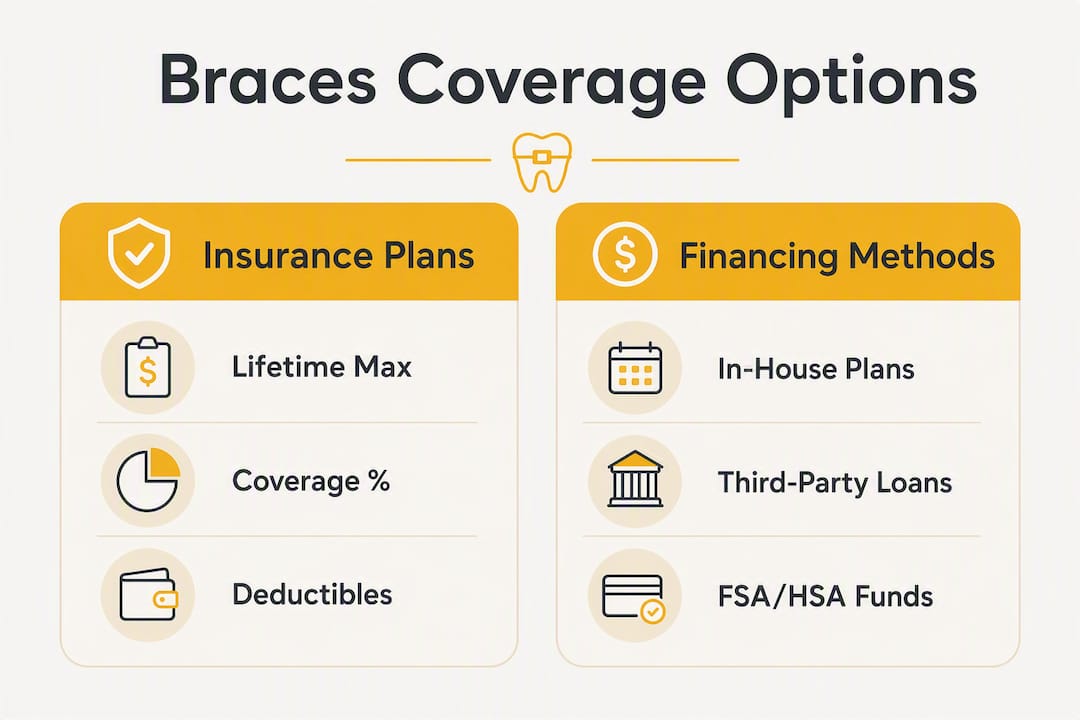
Three options cover most families: in-house payment plans, third-party lenders, and FSA/HSA accounts. Most people end up using a combination.

| Feature | In-house plan | Third-party lender | FSA/HSA |
|---|---|---|---|
| Credit check required | Rarely | Usually yes | No |
| Interest risk | None (typically) | Deferred-interest risk | None |
| Typical term | 12–24 months | 12–60 months | Plan year rules apply |
| Application speed | Same day | 1–3 days | Immediate |
| Who handles claims | Practice | Lender | You or practice |
In-house plans carry no credit check and are negotiated directly with the practice, which means terms can flex around your budget. Third-party lenders can extend your repayment window, but approval depends on your credit history, and many use deferred-interest models.
Watch out for deferred-interest promotions. A “0% for 18 months” offer from a medical lender is not the same as a true 0% APR loan. If you carry any balance at the end of the promotional period, the lender can charge interest retroactively on the original amount, not just what remains. Consumer warnings on this are consistent: verify the exact payoff schedule required and set a calendar reminder two months before the promo ends.
Worked example on a $5,000 case:
- In-house 0% over 24 months: $500 down, then roughly $188/month. Total cost: $5,000.
- Deferred-interest promo (missed payoff): Same monthly math, but a missed final payment triggers retroactive interest on the full $5,000. Total cost: significantly higher.
- FSA ($2,750 front-loaded) + small in-house balance: Out-of-pocket drops to roughly $2,250 spread over the remaining term.
What do braces and Invisalign typically cost?
Full treatment commonly falls between $3,000 and $8,000, depending on appliance type, case complexity, and your location. Full orthodontic treatment typically costs between $3,000 and $8,000, depending on appliance type and case complexity, with out-of-pocket costs after insurance and pre-tax account benefits often much lower.
Costs families often forget to budget for:
- Retainers ($150–$600 per set, and you will need replacements over time)
- Replacement aligner trays if sets are lost or damaged
- Emergency repair visits for broken brackets or wires
- Possible lab fees for complex cases
Verify your insurance plan’s lifetime orthodontic maximum before you commit to financing. Many employer dental plans include orthodontic benefits, with lifetime maximums that can significantly affect out-of-pocket cost and should be verified before financing. Knowing that number changes your math.
What questions should you ask at your consultation?
Use the consult to get a written, all-in estimate and a sample payment schedule. Leave with both documents in hand.
- What does the total fee include? (Adjustments, retainers, emergency visits?)
- What is the down payment, and is it negotiable?
- What is the monthly payment and the total number of payments?
- Is this true 0% APR or a deferred-interest promotion?
- Will you contact my insurer and apply my benefit directly?
- Can I use my FSA or HSA, and how does the office handle that paperwork?
- What happens if I need to pause or cancel treatment?
Red flags to watch for in contracts:
- Vague language like “additional fees may apply” with no cap or definition
- End-of-promotion clauses that are buried in fine print
- Required arbitration clauses that limit your options if a dispute arises
- Retainer policy that is not spelled out in writing
Which financing approach fits your family’s situation?
A few common profiles and the option that usually works best:
- Family with active dental insurance and an FSA: Apply your insurance lifetime maximum first, then use FSA/HSA funds to reduce the remaining balance as much as plan rules allow. Any balance left can be paid with an in-house payment plan. This method often results in the lowest possible out-of-pocket cost.
- Parent with a lower credit score: In-house plans are built for this. No hard credit pull, terms set by the practice, and you avoid the risk of a lender denial delaying treatment.
- Adult with no orthodontic insurance: A third-party lender with a longer term (36–60 months) can keep monthly payments manageable, but only if you can guarantee payoff before any promotional period ends. Otherwise, an in-house plan at a slightly higher monthly payment is the safer choice.
| Scenario | Likely best option | Why |
|---|---|---|
| Insurance + FSA available | Stack both, small in-house balance | Lowest total out-of-pocket |
| No insurance, good credit | Third-party lender (true 0% APR) | Extended term, manageable payments |
| No insurance, limited credit | In-house plan | No credit check, flexible terms |
| Adult, no ortho coverage | In-house or HSA + in-house | Avoids deferred-interest risk |
How Gloworthodontics handles coverage and payment
Gloworthodontics takes a consultation-first approach: every payment plan is built after the clinical assessment, not before, so the numbers reflect your actual case. The practice offers transparent, all-in pricing with a written estimate and a sample payment schedule provided at the consult.
What patients can expect:
- Low-cost or free initial consultation
- Written all-in estimate covering treatment, adjustments, and retainers
- In-house 0% payment plans that typically require no credit check
- Assistance with insurance verification and FSA/HSA paperwork
- Online booking and clear contact information
- Patient reviews available to read before you commit
Bring to your consult: your insurance card, FSA/HSA account details, and a rough monthly budget. The team will build a plan around those numbers on the spot.
Pro Tip: Read the braces insurance coverage guide on the Gloworthodontics site before your appointment. Knowing your lifetime maximum and what your plan excludes takes about ten minutes and gives you a stronger starting position at the consult.
Clear pricing, no surprises: book your consult with Gloworthodontics
Families who walk into a Gloworthodontics consultation leave with a written estimate, a payment schedule, and a clear picture of what treatment will cost after insurance and FSA/HSA are applied. That is the concrete difference from practices that quote a number verbally and fill in the details later.

At your first visit, the team will complete a clinical exam, walk through your appliance options (including Invisalign and traditional braces), and present a written financing plan before you make any decision. Bring your insurance card and FSA/HSA information. If you have teens starting treatment, the orthodontic care guide for teens on the site covers what to expect at every stage.
Book your consultation at Gloworthodontics and get your personalized written estimate the same day.
Key Takeaways
The best dental coverage for braces combines transparent all-in pricing, true interest-free payment options, and the ability to stack insurance and FSA/HSA funds, all confirmed in writing before treatment begins.
| Point | Details |
|---|---|
| Get everything in writing | Request a written all-in estimate and payment schedule at your consult before signing. |
| Stack your benefits | Apply your insurance lifetime maximum first, then layer FSA/HSA funds to cut out-of-pocket cost. |
| Prefer in-house plans | In-house 0% plans typically require no credit check and carry no deferred-interest risk. |
| Watch deferred-interest offers | A missed payoff on a promotional plan triggers retroactive interest on the full original balance. |
| Gloworthodontics | Offers consultation-first pricing, written estimates, in-house 0% plans, and insurance/FSA assistance. |
Why transparent payment structures actually improve treatment outcomes
Most people focus on the monthly payment number and stop there. The more important variable is predictability. When a family knows exactly what they owe, when each payment is due, and what happens if a retainer breaks, they are far less likely to skip appointments or abandon treatment early. Incomplete orthodontic treatment is genuinely costly, both financially and clinically.
Practices weigh real tradeoffs when designing payment options. Offering in-house plans means absorbing some administrative overhead and accepting that some accounts will need adjustment. But the alternative, pushing every patient toward a third-party lender, shifts risk onto families who may not fully understand deferred-interest mechanics. The practices that handle this well are the ones that explain the difference clearly and let the patient choose with full information.
If financial hardship arises during treatment, contact the office directly and early. Most practices, including Gloworthodontics, would rather adjust a payment schedule than see a patient stop coming in. The AAOF Gifted Smiles program also provides donated treatments for qualifying patients who need additional assistance.
Useful sources and further reading
For authoritative guidance on orthodontic costs, payment options, and pre-tax account rules, these are the primary sources worth bookmarking:
- How Much Do Braces Cost? Factors, Insurance, and Savings — American Association of Orthodontists
- Do Orthodontists Offer Payment Plans? — AAO, covering in-house plans, third-party financing, and consultation-first advice
- AAOF Donated Treatments — AAO Foundation program for qualifying patients who need financial assistance
- How to Afford Braces — practical cost ranges, FSA/HSA strategy, and insurance stacking guidance
- Does CareCredit Cover Braces? — LegalClarity, covering third-party lender risks and alternatives