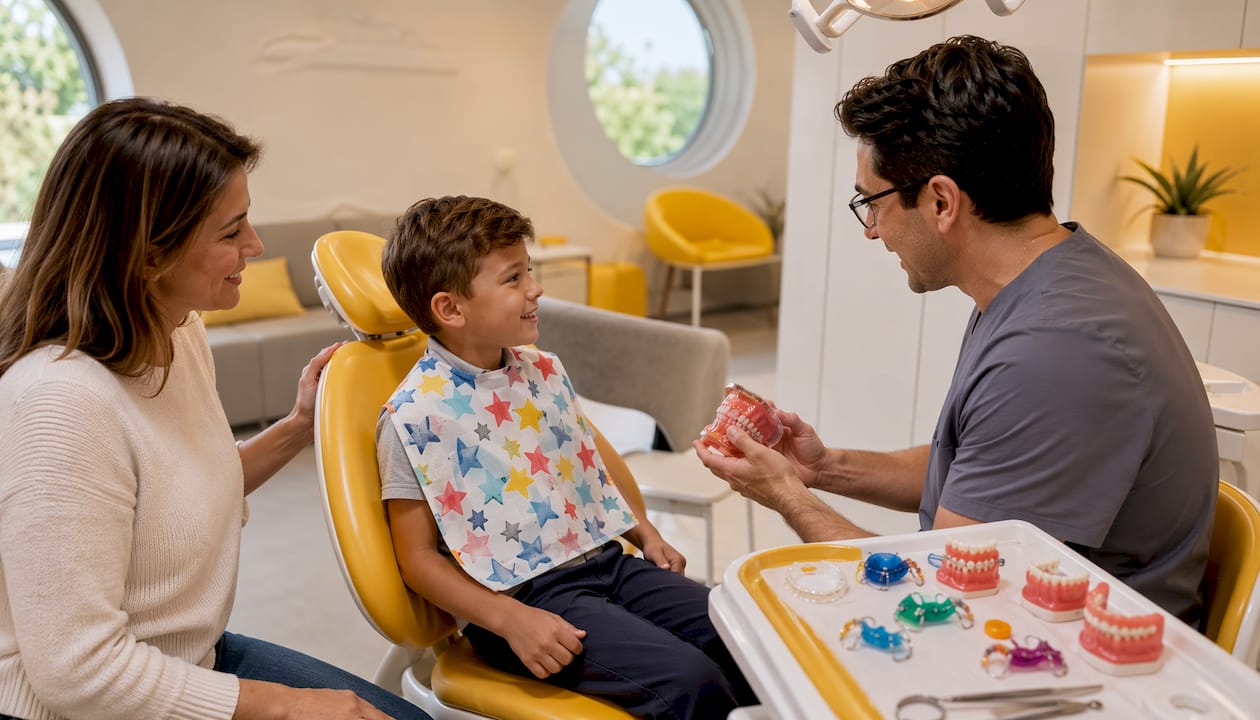
Pediatric orthodontic appliances fall into three main groups: fixed appliances (cemented in place by a clinician), removable appliances (including functional plates and clear aligner systems for kids), and auxiliaries (small tools like separators, elastics, and wax that support active treatment). Here is how each group maps to the most common clinical goals:
- Fixed appliances — expand the jaw, hold space after early tooth loss, guide jaw growth, or align teeth; used when daily compliance cannot be guaranteed
- Removable appliances — correct mild-to-moderate crowding, guide jaw development, or maintain results; require consistent daily wear
- Auxiliaries and tools — support fixed or removable treatment (separators create space before bands, elastics correct bite, wax manages discomfort)
The American Association of Orthodontists recommends an orthodontic evaluation no later than age 7, when enough permanent teeth have erupted to identify developmental issues early.
Table of Contents
- Fixed vs. removable: what the difference means for daily life
- Fixed appliances used in children: a practical catalog
- Removable appliances and aligner options for kids
- Small tools and auxiliaries parents will encounter
- How orthodontists choose an appliance and what to ask at the consult
- Typical timelines and costs: what to expect
- Why early evaluation changes what is possible
- Practical care and hygiene: daily routines that actually work
- Key Takeaways
- What families often miss about appliance choices
- Glow Orthodontics: what a first pediatric visit looks like
- Useful sources for further reading
Fixed vs. removable: what the difference means for daily life
The single most practical distinction in child-friendly orthodontic tool types is whether the appliance stays in or comes out. Fixed appliances are cemented or bonded by the orthodontist and cannot be removed at home. Removable ones are worn on a schedule and taken out for eating, brushing, and sports.
| Dimension | Fixed appliances | Removable appliances |
|---|---|---|
| Compliance burden | None — child cannot remove it | High — child must wear many hours daily |
| Hygiene impact | Harder; requires interdental brushes and water flosser | Easier; device is cleaned separately |
| Durability | High, but repairs need a clinic visit | Moderate; trays/plates can crack or be lost |
| Visibility | Varies (metal brackets visible; expanders mostly hidden) | Clear aligners nearly invisible; plates visible when speaking |
| Typical age/stage | Mixed or permanent dentition; Phase 1 or Phase 2 | Mixed dentition for plates; permanent for aligners |
| Common purposes | Space maintenance, jaw expansion, bite correction, alignment | Mild alignment, jaw guidance, retention |
The fixed-vs-removable choice is rarely about preference. Clinicians base it on the child’s age, dental development stage, the nature of the problem (skeletal vs. dental), and a realistic assessment of whether the child will wear a removable device consistently enough to work.
The choice often comes down to growth timing. A palatal expander placed during active jaw growth can accomplish in months what would require surgery in adulthood. That window closes, which is why the appliance type and the timing matter together.
Fixed appliances used in children: a practical catalog
Palatal expander
A palatal expander widens the upper jaw by applying gentle, steady pressure to the two halves of the palate before the midpalatal suture fuses (typically before the mid-teens). Parents or the child turn a small key in the center of the device, usually once daily. The first week brings a noticeable gap between the front teeth and some speech changes, both of which resolve as treatment progresses. Cleaning requires an interdental brush or a water flosser aimed at the roof of the mouth after every meal.
Space maintainer (Band & Loop, Nance holding arch)
When a primary tooth is lost early, a space maintainer holds the gap open so the permanent tooth can erupt correctly. The Band & Loop is a single-tooth solution: a metal band on the adjacent molar with a wire loop extending into the space. The Nance holding arch spans the upper arch and rests a small acrylic button against the palate. Both are fixed appliances that trap food easily, so interdental brushes are non-negotiable.
Lower lingual holding arch (LLHA)
The LLHA sits on the inside of the lower teeth, connecting two molar bands with a wire that runs along the tongue side of the arch. It holds lower molar position and prevents space loss in the lower jaw. Because it sits lingually, it is nearly invisible from the outside, though children often notice it with their tongue for the first week or two.
Quad helix
A quad helix is a spring-loaded expander bonded to upper molars with four helical coils that expand the upper arch gradually. Unlike a palatal expander, it does not require daily activation by a parent, which some families find easier to manage. It is typically used in younger children during the primary or early mixed dentition.
Herbst appliance and Twin Block
These functional appliances guide lower jaw growth forward, correcting significant overbites in growing children. The Herbst is fixed (telescoping metal rods connect upper and lower molars), while the Twin Block is removable (two interlocking acrylic blocks worn together). Both are most effective during the pubertal growth spurt. The first week often involves soreness and altered chewing; soft foods help considerably. For the first week of braces or a new appliance, cold foods like yogurt and smoothies are genuinely useful.
Fixed braces (metal and ceramic brackets)
Traditional metal brackets bonded to each tooth, connected by an archwire, remain the most versatile and durable option for comprehensive alignment. Ceramic brackets are less visible but more fragile than metal and can require more frequent repairs in active younger kids. For children in sports or those prone to rough play, metal brackets hold up better.
| Appliance | Typical age/stage | Wear time |
|---|---|---|
| Palatal expander | 7–14 (mixed dentition) | 3–6 months active + retention |
| Band & Loop / Nance | Primary/mixed dentition | Until permanent tooth erupts |
| LLHA | Mixed dentition | 1–3 years |
| Quad helix | Primary/early mixed | 3–6 months |
| Herbst appliance | Pubertal growth spurt | 9–18 months |
| Fixed braces | Mixed/permanent dentition | 18–30 months |
Pros for children: compliance-free, consistent force, no risk of being lost or forgotten.
Cons: food trapping, harder hygiene, temporary speech changes lasting 3–7 days after placement, and repairs require a clinic visit.
Pro Tip: Pack a small “braces kit” in your child’s backpack: orthodontic wax, two interdental brushes, a compact mirror, and a spare elastic. Most minor issues at school — a poking wire, a loose bracket edge — can be managed until the next appointment without an urgent visit.
Removable appliances and aligner options for kids
Removable orthodontic devices range from simple retainer-style plates to sophisticated clear aligner systems designed for mixed dentition. The Hawley retainer, the most familiar removable device, uses a wire across the front teeth and an acrylic plate to hold tooth position after active treatment. Removable functional plates (similar in concept to the Twin Block) guide jaw development in younger children who can reliably wear them.
Clear aligner systems for children differ from adult aligner therapy in one important way: they include compliance indicators (small blue dots on the trays that fade with wear) and eruption tabs that accommodate incoming permanent teeth — learn more about these options at Invisalign – CASA DENTALIS. They work well for mild-to-moderate crowding in cooperative children, typically those 10 and older with most permanent teeth present.
Removable appliances only work when worn. A child who removes a plate at school, forgets it at a friend’s house, or leaves it on a lunch tray will not progress on schedule. Before choosing a removable option, be honest with yourself about your child’s maturity and your family’s ability to monitor wear time consistently.
The compliance trade-off is real. Removable devices are easier to clean (the child brushes normally, then cleans the device separately), allow normal eating without food restrictions, and cause less gum irritation. But they require 20–22 hours of daily wear to deliver the planned force. A child who wears aligners only at night gets roughly half the prescribed treatment time.
A practical scenario where removable wins: a 10-year-old with mild crowding, no skeletal discrepancy, and a track record of following through on responsibilities. A scenario where fixed is the better call: a 7-year-old needing jaw expansion who is unlikely to wear a removable expander consistently. For aligner-specific eating and care guidance, the rules are straightforward but worth reviewing before the first tray.

Clinicians typically schedule removable-appliance patients every 6–10 weeks to check wear compliance, assess progress, and adjust the device. Missing these appointments is a common reason treatment stalls.
Pro Tip: Use a timer app or a simple sticker chart to track daily wear hours. Gamifying hygiene and wear time measurably improves compliance in younger patients — small rewards for hitting weekly wear goals work better than reminders alone.
Small tools and auxiliaries parents will encounter
These items are not appliances on their own, but they are part of almost every child’s orthodontic experience.
- Separators (spacers): Small rubber rings placed between molars 5–7 days before band placement to create space. They feel like a popcorn kernel stuck between teeth. Avoid sticky or chewy foods while they are in place.
- Elastics (rubber bands): Worn between upper and lower hooks to correct bite relationships. Children should replace them as directed (usually daily) and never double up without instruction.
- O-rings (ligature ties): The small colored rings that hold the archwire to each bracket. They are changed at every adjustment appointment and are a fun way for kids to personalize their braces.
- Orthodontic wax: Pressed over a bracket or wire end that is causing irritation. It is safe if swallowed in small amounts. Keep a fresh supply in the braces kit.
- Interdental brushes: Small cone- or Christmas-tree-shaped brushes that clean between brackets and under wires far more effectively than standard floss.
- Water flosser: Particularly useful for children with palatal expanders or fixed space maintainers where floss cannot reach easily.
Safety note: Elastics and small detachable components are a choking consideration for very young children. Supervise elastic use in children under 8, and keep loose bands and separators out of reach of younger siblings.
Pro Tip: If a wire is poking and wax is not holding, use a clean pencil eraser to gently tuck the wire end against the last bracket. If a band comes loose and causes pain, call the clinic the same day — a dislodged band can cause tooth movement in the wrong direction.
How orthodontists choose an appliance and what to ask at the consult
Appliance selection is not a menu choice. Clinicians weigh five factors: the child’s age and dentition stage, whether the problem is skeletal (jaw position) or dental (tooth position), the child’s maturity and likely compliance, current oral health (active cavities disqualify some appliances), and remaining growth potential.
The best appliance is the one that solves the right problem at the right time. An expander placed two years too late cannot move bone the way it would have during active growth. Timing is a clinical decision, not a preference.
Questions worth asking at the consult:
- Why this appliance specifically, and what is the alternative?
- What happens if we wait six months?
- How long will this phase take, and what does Phase 2 look like?
- How will this affect brushing and flossing?
- How often are follow-up appointments, and what do they involve?
- What counts as an emergency, and how do we reach you?
Red flags that warrant a second opinion:
- No clear timeline or measurable goal stated
- No discussion of hygiene impact or food restrictions
- No mention of what happens if the child does not comply
- Pressure to start immediately without a written treatment plan
Preparing a list of questions before the appointment makes the consult more productive and helps you evaluate whether the clinician’s reasoning is clear and specific.
Pro Tip: Ask the orthodontist to show you the before-and-after records of a similar case. A clinician who can walk you through a comparable patient’s records is demonstrating both experience and transparency.
Typical timelines and costs: what to expect
Treatment length and cost vary by case, but these general signals help with planning.
Timeline signals by appliance or phase:
- Separators: 5–7 days
- Palatal expansion (active phase): 3–6 months, followed by 6 months of retention in the expander
- Phase 1 interceptive treatment: typically 9–18 months
- Fixed braces (Phase 2): 18–30 months for most cases
- Retainer phase: indefinite wear (nightly) after active treatment ends
Cost drivers to ask about:
- Appliance type (a simple Band & Loop costs far less than a Herbst or a full aligner series)
- Case complexity and number of phases
- Whether surgical or multidisciplinary care (speech therapy, oral surgery) is needed
- Insurance coverage and what your plan classifies as “medically necessary”
- Repair and replacement fees for lost or broken removable devices
As a general signal, simple space maintainers sit at the lower end of the cost range, fixed braces in the middle, and functional appliances or clear aligner systems toward the higher end. Prices vary significantly by region, provider, and case complexity. Asking for a written fee estimate that itemizes appliance cost, adjustment visits, and repair policy is reasonable and expected. If your child may need dental insurance coverage for aligner treatment, reviewing your plan’s orthodontic benefit before the consult saves time.
Why early evaluation changes what is possible
The American Association of Orthodontists recommends an orthodontic evaluation by age 7. At that age, the first permanent molars and incisors have typically erupted, giving a clinician enough information to assess jaw relationships, crowding, and bite problems that are far easier to address during active growth.
Early evaluation does not mean early treatment. Many children evaluated at age 7 are monitored and begin treatment at 10 or 11. But for those who do need Phase 1 care, the window for certain appliances is genuinely time-limited.
What early evaluation makes possible: palatal expansion before the midpalatal suture fuses, functional jaw guidance during the growth spurt, and space management that reduces the likelihood of extractions later. The American Academy of Pediatric Dentistry supports early referral to an orthodontist when a pediatric dentist identifies a developing problem, even before age 7 in cases of severe crowding, crossbite, or thumb-sucking habits.
Growth-based treatments are safe and well-monitored. Orthodontists track skeletal development with periodic imaging and adjust timing based on the child’s individual growth curve, not a fixed calendar.
Practical care and hygiene: daily routines that actually work
For fixed appliances
- Brush for two minutes after every meal using a soft-bristle electric toothbrush on sensitive mode, angling the brush head at 45 degrees toward the gumline and then toward the bracket.
- Use an interdental brush to clean under the archwire and between brackets after brushing.
- Use a water flosser once daily to flush debris from around bands and expander arms.
- Apply a fluoride rinse at night, after brushing, to reduce white-spot lesion risk around brackets.
- Avoid hard, sticky, and chewy foods (ice, caramel, hard pretzels, whole apples) throughout treatment.
For a detailed brushing technique, the step-by-step brushing guide walks through the correct motion for brackets and wires.
For removable appliances and aligners
- Remove the device before eating or drinking anything other than plain water.
- Rinse the device with cool water immediately after removal.
- Clean with a soft toothbrush and mild dish soap or a retainer-cleaning tablet; never use toothpaste (it scratches the surface and creates bacterial hiding spots).
- Store in the provided case, not a napkin — lost trays are one of the most common and avoidable treatment delays.
Troubleshooting flow:
- Mild soreness after an adjustment or new tray: soft foods, cold water, over-the-counter pain relief if needed
- Persistent pain or a loose band: call the clinic within 24 hours
- Lost removable tray or plate: wear the previous tray as a backup and call the clinic the next business day
- Poking wire: apply wax; if it cannot be managed, call the clinic for a same-day trim
A cavity-prevention routine during treatment matters as much as the appliance itself. Decalcification around brackets is one of the most common and preventable complications of braces in children.
Key Takeaways
The most important decision in pediatric orthodontics is whether a fixed or removable appliance fits the child’s age, dental development, and realistic compliance level.
| Point | Details |
|---|---|
| Fixed vs. removable | Fixed appliances remove compliance burden; removable options require 20–22 hrs/day of consistent wear to work. |
| AAO age-7 evaluation | An orthodontic evaluation by age 7 identifies candidates for time-sensitive interceptive treatment. |
| Appliance purpose matters | Each device targets a specific problem: expansion, space maintenance, jaw guidance, alignment, or retention. |
| Hygiene is non-negotiable | Combining an electric toothbrush, interdental brushes, and a water flosser is the standard recommendation for braces care. |
| Gloworthodontics | Glow Orthodontics offers pediatric-focused evaluations and a range of appliance options — book a consult to get a written treatment plan. |
What families often miss about appliance choices
The conversation around pediatric orthodontics tends to focus on aesthetics: metal vs. clear, visible vs. invisible. That framing misses the more consequential question, which is timing. A child who needs jaw expansion at age 9 and gets it at 14 may need surgical intervention instead. The appliance itself is almost secondary to whether it is used at the right developmental moment.
Compliance is also more nuanced than “will my child wear it.” Fixed appliances sidestep the compliance problem entirely, which is why clinicians often recommend them for younger children regardless of the child’s stated willingness to wear a removable device. A motivated 8-year-old who promises to wear a plate 22 hours a day is still an 8-year-old.
The families who navigate treatment most smoothly tend to share one habit: they ask specific questions at every appointment and write down the answers. Not “how is it going?” but “what is the current measurement, and what is the target?” Orthodontic treatment is measurable. If a clinician cannot give you a number, ask again.
Glow Orthodontics: what a first pediatric visit looks like
Families who want a clear, no-pressure starting point get exactly that at Gloworthodontics. The first appointment covers a clinical evaluation matched to the child’s age and dentition stage, digital imaging or a 3D scan where indicated, a plain-language explanation of any issues found, and an honest conversation about timing, appliance options, and what insurance typically covers.

Gloworthodontics works with children across a range of treatment phases, from early interceptive care (palatal expanders, space maintainers) through comprehensive braces and clear aligner options for older kids and teens. The team explains every appliance in terms families can actually use, including hygiene impact, food restrictions, and what to expect in the first week. For families exploring aligner options specifically, the orthodontic care guide for teens covers the full range of options for older children. If you want to compare fixed and clear options side by side, the clear braces vs. Invisalign breakdown is a practical starting point. Book a consultation at gloworthodontics.ca to get a written treatment plan and a timeline your family can plan around.
Useful sources for further reading
- American Association of Orthodontists — The AAO’s patient resources explain the age-7 evaluation recommendation and what to expect from Phase 1 and Phase 2 care.
- American Academy of Pediatric Dentistry — Clinical guidelines on early orthodontic referral and space management in primary and mixed dentition.
- Cleveland Clinic: Teeth & Braces — A clear, medically reviewed overview of braces types, timing, and what the process involves for children and adults.
- American Dental Association — Patient-facing resources on orthodontic treatment, oral hygiene during braces, and finding a qualified provider.
- Gloworthodontics hygiene guide — Clinic-specific brushing and care instructions for children in active treatment.
- Orthodontic emergencies guide — What counts as an urgent issue, what can wait, and how to reach the clinic when something goes wrong.
The AAO’s age-7 evaluation recommendation is not about starting treatment early. It is about identifying the children who will benefit from time-sensitive interceptive care before the growth window closes. Most children evaluated at 7 are simply monitored — but for those who need early intervention, that appointment makes a measurable difference.
This article is general information for educational purposes and does not substitute for professional orthodontic or dental advice. Confirm treatment recommendations and timing with a licensed orthodontist based on your child’s specific clinical situation.