Invisalign treatment typically takes 6 to 18 months for most adults, with 12 months being the statistical midpoint for moderate cases — but your actual timeline depends almost entirely on case complexity and how consistently you wear your aligners.
- Fastest typical case: Express/Go tier for minor crowding or spacing, with shorter active wear duration
- Most common adult range: Moderate cases generally take about 12 months
- Complex cases: Cases involving significant bite correction or severe crowding may require extended treatment times, potentially exceeding a year and a half, especially when refinements are needed.
“While only a doctor can say exactly how long your treatment will take, you could see your new smile in as little as 6 months — and start seeing changes in just a few weeks.” — Align Technology (Invisalign.com)
Glow Orthodontics provides a clinician-backed timeline estimate at your first consultation, so you leave with a realistic personal projection, not a marketing range.
Table of Contents
- How long is Invisalign treatment by version and case type?
- What the full Invisalign treatment timeline actually looks like
- What actually makes your Invisalign treatment take longer or shorter
- Three realistic example timelines
- How to stay on schedule and potentially shorten your treatment
- Retention: the phase that never really ends
- How treatment length affects cost and insurance
- Key Takeaways
- The timeline conversation most patients skip
- Glow Orthodontics offers a clear timeline from day one
- Useful sources
How long is Invisalign treatment by version and case type?
Invisalign by Align Technology comes in tiered product lines, and each tier maps to a different severity level. Invisalign offers tiered product lines corresponding to different case severities, with increasing aligner counts and treatment durations for more complex cases. Total calendar time includes pre-treatment setup, which is often overlooked by patients; exact figures are personalized and vary by individual.
When your clinician will recommend a shorter vs. longer tier:
- Express/Go: Small gaps, mild crowding, minor relapse after prior orthodontic treatment
- Lite/Moderate: Noticeable crowding, moderate spacing, mild bite discrepancy
- Comprehensive/Full: Significant crowding, bite correction (overbite, underbite, crossbite), multiple simultaneous movements
- Teen: Comprehensive-level movements with extra compliance indicators built in
The “12-month average” you see quoted widely is a statistical midpoint for moderate adult cases — a guide, not a guarantee. Individual biology and compliance shift that number in both directions.
What the full Invisalign treatment timeline actually looks like
Most patients think treatment starts the day they pick up their aligners. The real clock starts earlier.
Phase-by-phase breakdown
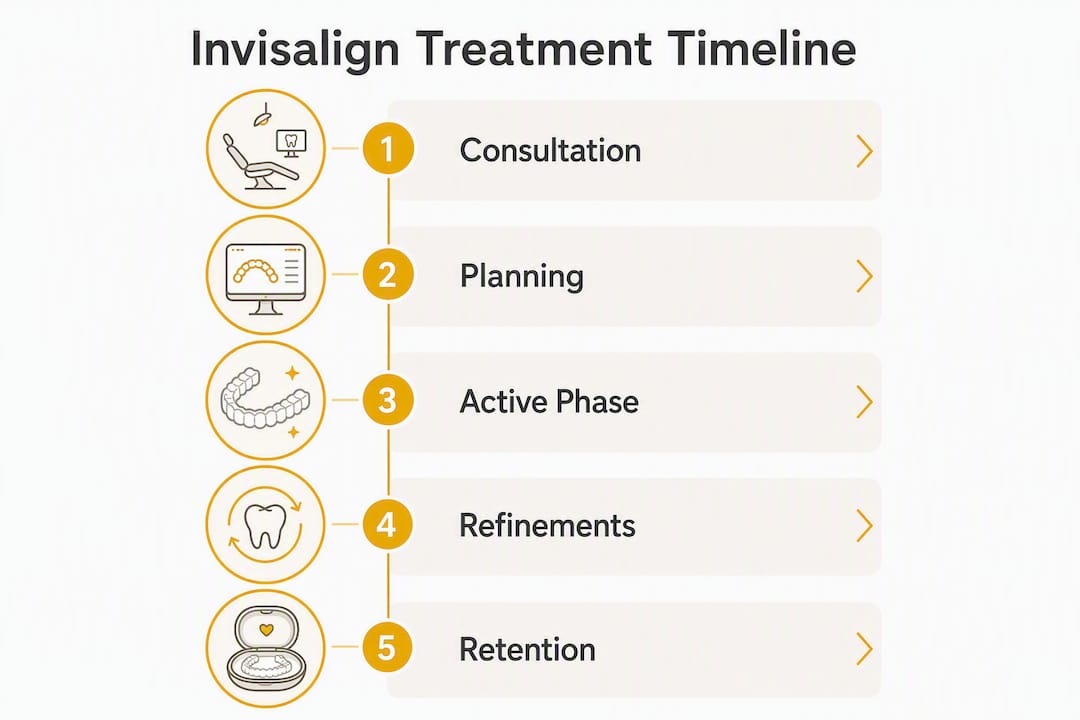
- Consultation and digital scans (1–2 weeks): Your orthodontist takes iTero digital scans or impressions and photographs. No aligners yet.
- ClinCheck treatment planning and approval (1–2 weeks): Align Technology’s software generates a 3D tooth-movement simulation. Your clinician reviews it, requests revisions if needed, and approves the final plan.
- Aligner fabrication and shipping (2–3 weeks): Aligners are manufactured and shipped to the clinic. This step alone adds 2–4 weeks to your total calendar time before you wear a single tray.
- Active aligner phase (3–18+ months): You wear each set for 7–14 days, removing them only to eat, drink anything other than water, and brush. Aligner changes occur every 7–14 days; review visits happen every 6–8 weeks.
- Refinement rounds, if needed (4–12 weeks each): When teeth don’t track exactly to the ClinCheck plan, new scans are taken and a fresh set of aligners is fabricated. Refinements add roughly 1–3 months per round.
- Retention phase (lifelong): Active treatment ends; retainer wear begins immediately.
Pro Tip: The checkpoints most likely to trigger refinements are the 6-month and 12-month review visits. If your teeth aren’t tracking the ClinCheck plan at those milestones, your clinician will initiate a refinement scan rather than push forward with misaligned trays. Catching it early keeps the added time to a minimum.
| Phase | Typical Duration |
|---|---|
| Consultation and scans | 1–2 weeks |
| ClinCheck planning | 1–2 weeks |
| Aligner fabrication | 2–3 weeks |
| Active wear (mild) | 3–6 months |
| Active wear (moderate) | 10–14 months |
| Active wear (complex) | 14–18+ months |
| Refinements (if needed) | 4–12 weeks per round |
| Retention | Lifelong |

What actually makes your Invisalign treatment take longer or shorter
Case complexity is the biggest factor overall, but it’s the one you can’t control. Here’s the full picture, ranked roughly by impact.
Case complexity (highest impact): The amount of tooth movement required drives aligner count more than anything else. Minor crowding needs fewer aligners; correcting a significant overbite or underbite requires precise, staged movements that simply take more time.
Wear-time compliance (biggest controllable factor): Aligners need to be worn 20–22 hours per day to move teeth on schedule. Dropping below roughly 18 hours consistently can extend treatment by a meaningful margin — and no amount of catching up later fully compensates for lost wear time.
Wearing aligners for only 16–18 hours a day instead of the recommended 20–22 can extend your total treatment time proportionally. The math is straightforward: less time in the aligner means less force applied, which means slower movement.
Age and bone biology: Younger bone remodels faster, which is why teen cases often move at a quicker pace than comparable adult cases. Adults with denser bone may need 3–6 additional months for the same degree of movement.
Additional factors that add time:
- Attachments and elastics: Small tooth-colored bumps bonded to teeth improve aligner grip for complex movements but require precise placement and monitoring.
- Interproximal reduction (IPR): Slight reshaping between teeth to create space; adds a step at certain review visits.
- Extractions or surgery: Pre-treatment extractions or jaw surgery add months before active aligner wear even begins.
- Missed appointments: Each skipped review visit delays the chance to catch tracking issues early, compounding delays.
- Lab and ClinCheck revision cycles: If your clinician requests multiple revisions to the ClinCheck plan before approving it, fabrication is delayed. Administrative scheduling gaps at the clinic level can also push back start dates.
Avoiding common care mistakes during treatment, like eating with aligners in or skipping hygiene steps, also protects your timeline.
Three realistic example timelines
These examples show how the phases add up for different case types.
-
Mild case (minor crowding or small gap): 20–30 aligners, 7-day change cadence, 3–6 months active wear. Add 3–4 weeks of pre-treatment setup and you’re looking at roughly 4–7 months total. Refinements are less common at this level.
-
Moderate case (noticeable crowding, mild bite issue): 40–50 aligners, 7–14 day changes, approximately 12 months active. One refinement round is plausible, adding 6–10 weeks. Total calendar time: 13–16 months including setup.
-
Complex case (significant bite correction, severe crowding): 60+ aligners, comprehensive movements, 14–18+ months active. Refinements are common and may occur more than once. Total calendar time can reach 18–24 months or beyond when adjunctive treatments like IPR or extractions are involved.
| Case Type | Aligner Count | Active Months | Total Calendar Time |
|---|---|---|---|
| Mild | 20–30 | 3–6 months | 4–7 months |
| Moderate | 40–50 | 12 months | 13–16 months |
| Complex | 60+ | 14–18+ months | 18–24+ months |
How to stay on schedule and potentially shorten your treatment
The patients who finish on time share a few consistent habits. None of them are complicated.
- Wear aligners 20–22 hours every day. Remove them only to eat, drink anything other than water, and brush. This single habit has more impact on your finish date than anything else.
- Use a wear-time tracker. A simple phone timer or a dedicated app helps you catch short days before they become a pattern. Some clinics also offer remote monitoring tools that log wear data automatically.
- Switch aligners on schedule. If your plan calls for a 7-day change, don’t stretch it to 10 because the tray feels comfortable. Comfort often means the movement is complete — time to advance.
- Attend every review visit. Check-ups every 6–8 weeks let your clinician catch tracking problems early. A missed appointment delays that catch by weeks.
- Report tracking issues immediately. If an aligner feels loose or a tooth isn’t moving as expected, call the clinic rather than waiting for your next scheduled visit.
- Follow elastics and attachment instructions exactly. These mechanics are doing specific jobs in your treatment plan. Skipping them stalls those movements.
Pro Tip: Ask your clinician whether remote monitoring via photo uploads is available. Submitting weekly photos through an app like Dental Monitoring can reduce unnecessary in-office visits and flag tracking issues faster than a 6-week check-up cycle alone.
For more on building daily habits that protect your timeline, the practical tips for Invisalign life guide covers the routines that matter most.
Retention: the phase that never really ends
Active treatment finishing doesn’t mean your teeth are locked in place. Teeth have a natural tendency to drift back toward their original positions, which is why retention is a permanent commitment, not a short-term step.
Retainer types and typical wear schedules:
- Clear removable retainers (Vivera or similar): Worn 20–22 hours per day for the first 3–6 months post-treatment, then typically nights only long-term.
- Bonded wire retainers: A thin wire bonded behind the front teeth, providing continuous passive retention without any daily compliance requirement.
- Combination approach: Many clinicians use a bonded wire for the lower front teeth and a clear removable retainer for the upper arch.
Skipping retainer wear, even months after active treatment ends, allows teeth to shift. The risk of orthodontic relapse is highest in the first year post-treatment and remains present indefinitely without consistent retention.
Practical retainer care tips:
- Clean clear retainers daily with a soft toothbrush and mild soap, not toothpaste (which scratches the plastic).
- Store them in a case when not in use — heat and pets are the two most common causes of retainer loss or damage.
- Schedule a retention check-in at 3 months and again at 12 months post-treatment to confirm fit and catch any early shifting.
How treatment length affects cost and insurance
Longer treatment means more aligners, more review visits, and a higher likelihood of refinement rounds. Each of those adds to the total cost. Refinements may be included in your original treatment contract or billed separately depending on the clinic’s policy — ask before you start.
What to confirm with your insurer:
- Whether your plan covers Invisalign specifically or only “orthodontic treatment” broadly
- The lifetime orthodontic benefit cap (many US plans cap at $1,000–$2,000 regardless of treatment length)
- Whether preauthorization is required before treatment begins
- How refinements are classified — as part of the original treatment or a separate claim
Pro Tip: Ask your orthodontist for an itemized, timeline-based treatment estimate that separates the base aligner cost from potential refinement costs. This lets you structure a payment plan around the most likely scenario rather than the best-case one. Many offices offer in-house financing that can be adjusted if refinements extend the timeline.
For a deeper look at coverage specifics, the dental insurance for Invisalign guide breaks down what most US plans actually cover.
Key Takeaways
Most adults finish Invisalign in 12–18 months, but wear-time compliance is the single biggest controllable factor in whether you hit that window or extend past it.
| Point | Details |
|---|---|
| Typical adult range | Most moderate cases complete in 12 months; mild cases can finish in 4–7 months total. |
| Wear time is critical | Wearing aligners 20–22 hours per day keeps treatment on schedule; dropping below 18 hours extends it. |
| Refinements are common | Plan for 1–3 extra months if refinements are needed; discuss the policy at your first consultation. |
| Retention is lifelong | Retainer wear begins immediately after active treatment and continues indefinitely to prevent relapse. |
| Gloworthodontics | Provides a clinician-backed timeline estimate at consultation, covering aligner count, likely refinements, and a realistic calendar total. |
The timeline conversation most patients skip
There’s a version of the Invisalign timeline conversation that almost never happens at the first consultation, and it’s the one that matters most: what happens when things don’t go exactly to plan.
Refinements aren’t a sign that something went wrong. They’re a built-in feature of how Invisalign works. Teeth don’t always track the ClinCheck simulation perfectly, and a good clinician will catch that at a review visit and order a new set of aligners rather than push forward with trays that aren’t doing their job. The problem is that most patients hear “12 months” and treat it as a contract. When month 13 arrives and refinements are needed, they feel misled.
The honest framing is this: the 12-month figure is a midpoint, not a ceiling. A clinician who tells you “probably 12 months, possibly 14 if we need one refinement round” is giving you a more useful answer than one who quotes the statistical average and leaves it there. At Gloworthodontics, the approach is to walk through the ClinCheck plan with patients before treatment starts, flag which movements are the most ambitious, and set a realistic contingency window upfront. That conversation takes 10 extra minutes and saves months of frustration.
Compliance is the other piece patients underestimate. Not because they plan to skip wear time, but because life happens — a dinner out, a long meeting, a day when the aligners just feel uncomfortable. Those hours add up. A simple phone timer costs nothing and keeps the math honest.
Glow Orthodontics offers a clear timeline from day one
Getting a realistic Invisalign timeline shouldn’t require guesswork. At Gloworthodontics, every patient receives a clinician-backed estimate at their first consultation, built from digital scans and a full ClinCheck review, not a generic range pulled from a brochure.

The clinic’s process covers digital scanning, ClinCheck planning, active aligner monitoring, and remote check-in options that reduce unnecessary in-office visits without sacrificing oversight. Whether you’re looking at a 5-month Express case or an 18-month comprehensive plan, you’ll know the aligner count, the likely refinement scenario, and the total calendar time before you commit.
Ready to get a number you can actually plan around? Review the Invisalign treatment process at Gloworthodontics and book your consultation to get a personalized timeline from a clinician who will give you the full picture.
Useful sources
- Invisalign Treatment Timeline: How Long it Really Takes (Step-by-Step) — T. Lance Collier, DMD
- How Long Does Invisalign Take? Treatment Timelines Explained — Aesthetik
- Invisalign for Older Adults — Invisalign.com (Align Technology)
- How Long Does Invisalign Take? A Complete Patient Guide — Dental Designs
- Invisalign Treatment Process: Step-by-Step Guide — Gloworthodontics
- 7 Practical Tips for Everyday Life With Invisalign — Gloworthodontics