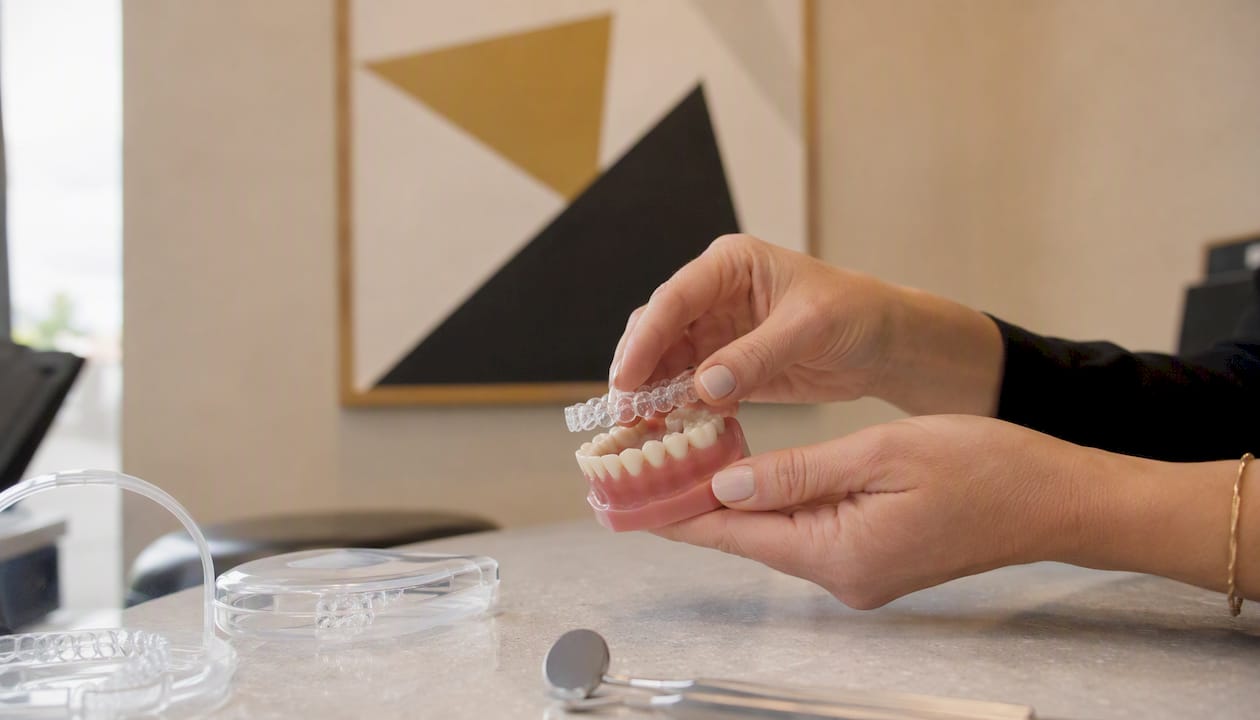
Yes, you can straighten your teeth without traditional metal braces, and for most mild to moderate cases, clear aligners are the standard first-line alternative. A randomized controlled trial found aligners produced comparable alignment outcomes to fixed appliances for mild to moderate crowding, with shorter treatment duration, less early pain, and zero enamel decalcification events versus 8.3% in the braces group. An international Delphi expert consensus confirms aligners are appropriate for many non-extraction Class I mild to moderate cases. The American Association of Orthodontists is clear that a specialist evaluation is required to select the appropriate appliance for your specific malocclusion.
Two qualifiers before you get excited: complex cases involving large rotations, skeletal discrepancies, or bite problems that affect jaw function may still require fixed braces or orthognathic surgery. And no online quiz or photo assessment replaces an in-person orthodontic evaluation with scans.
Quick self-check — signs you may be a candidate for aligners:
- Mild to moderate crowding or spacing in the front teeth
- Minor bite issues without significant jaw misalignment
- Teeth that are mostly straight but have shifted after previous treatment
- No history of severe gum disease or significant bone loss
Immediate next steps:
- Note which teeth look crowded, spaced, or rotated
- Check whether your bite feels off (upper and lower teeth not meeting evenly)
- Schedule a consultation with a licensed orthodontist for an intraoral scan and bite analysis
Key Takeaways
Clear aligners are the most evidence-supported non-brace option for mild to moderate crowding, with clinical trial data showing comparable alignment outcomes, shorter treatment duration, and fewer enamel complications than fixed appliances.
| Point | Details |
|---|---|
| Aligners work for mild–moderate cases | RCT evidence shows comparable alignment outcomes to fixed braces for mild to moderate crowding. |
| Treatment time averages 6–12 months | Many adult aligner cases complete in 6–12 months; complex cases or refinements extend that range. |
| Pain and hygiene advantages are real | Aligners showed lower pain scores (3.4 vs. 6.2 at 14 days) and 0% enamel decalcification vs. 8.3% with braces. |
| Complex cases still need fixed appliances | Large rotations, skeletal issues, and extraction cases are less predictable with aligners alone. |
| Gloworthodontics provides specialist evaluation | Gloworthodontics offers in-office scans, supervised aligner planning, and retention care for patients seeking non-brace options. |
Table of Contents
- What are your real options for straightening crooked teeth without braces?
- How clear aligners actually work — and what to expect day to day
- How do clear aligners compare to traditional braces?
- When veneers and bonding make sense — and when they don’t
- Who is actually a good candidate for aligners?
- What does the process look like, from consultation to retainers?
- What does the clinical evidence actually say?
- The thing most aligner guides get wrong
- Glow Orthodontics offers a clear path to specialist aligner care
- Sources
What are your real options for straightening crooked teeth without braces?
Not every option actually moves teeth. Some shift them orthodontically; others just change how they look. Knowing the difference saves you time, money, and a lot of frustration.
Options that move teeth:
- Clear aligners (e.g., Invisalign, ClearCorrect): Removable thermoplastic trays that apply controlled force to reposition teeth. The dominant non-brace option for mild to moderate cases.
- Ceramic (clear) braces: Fixed brackets made of tooth-colored ceramic. Less visible than metal, but still bonded to teeth. Not truly “brace-free,” but worth knowing they exist.
- Lingual braces: Fixed brackets placed on the inside surface of teeth. Invisible from the front, but more complex and typically more expensive.
Options that change appearance only:
- Porcelain veneers: Thin shells bonded to the front of teeth to mask minor spacing or shape irregularities. No tooth movement involved.
- Composite bonding: Tooth-colored resin applied to reshape or fill gaps. Faster and cheaper than veneers, but less durable.
A note on direct-to-consumer aligner kits: Mail-order aligners promise convenience, but the ADA warns that unsupervised tooth movement without imaging or professional monitoring carries real risks, including root damage and worsening bite problems. The savings are not worth the gamble.
How clear aligners actually work — and what to expect day to day
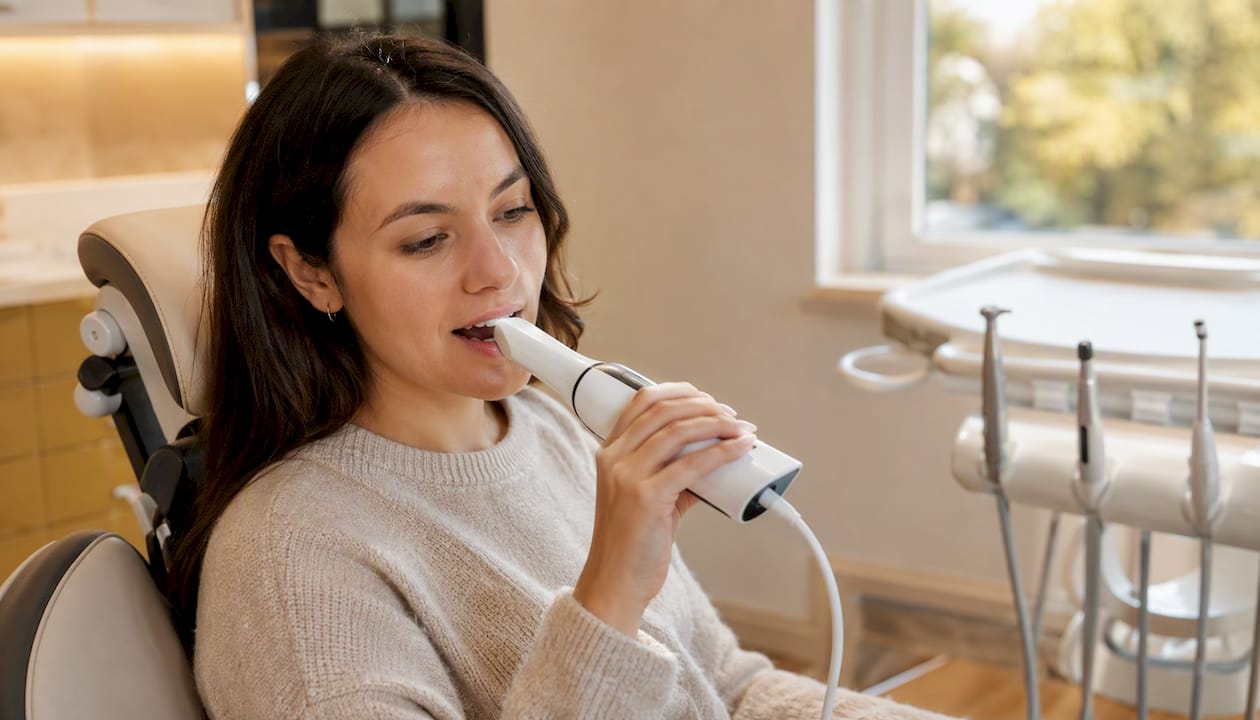
Clear aligners are removable thermoplastic trays fabricated from a digital 3D plan of your teeth. The workflow starts with an intraoral scan (no messy impressions), which feeds into a virtual treatment simulation showing each planned tooth movement. A series of staged aligner sets is then fabricated, each one moving teeth incrementally toward the final position.
Biomechanically, most of that movement happens through crown tipping — the visible part of the tooth tilts toward its target position. Predictable root control, large rotations, and certain vertical movements are harder to achieve with aligners alone. The Delphi consensus notes that planning these more complex movements increases the likelihood of needing refinements or switching to fixed appliances partway through.
Wear and compliance: Aligners need to be worn 20–22 hours per day. That means they come out only to eat, drink anything other than water, and brush. Trays typically change every 7–14 days, depending on your clinician’s protocol. Skipping wear time or stretching tray changes is the single most common reason treatment runs long.
Pros:
- Nearly invisible during wear
- Removable for meals and oral hygiene
- Lower rate of enamel decalcification compared to fixed brackets
- Fewer emergency appointments for broken brackets or wires
- Fewer white-spot lesions because patients can brush and floss normally
Cons:
- Compliance-dependent: results suffer if you don’t wear them consistently
- Less predictable for large rotations, significant vertical changes, or root torque
- Refinement trays (additional aligner sets) are common and extend total treatment time
- Attachments (small tooth-colored bumps bonded to teeth) are often needed to help aligners grip and move teeth more precisely
Daily care checklist:
- Rinse aligners with cool water every time you remove them
- Brush and floss before reinserting
- Clean trays with a soft toothbrush and mild soap — never hot water, which warps the plastic
- Store in the case when not in your mouth (not a napkin, not a pocket)
- Attend all scheduled check-ins so your clinician can catch any tracking issues early
Pro Tip: Set a phone alarm for the 22-hour mark. Most patients who fall short of wear time do it gradually — 20 minutes here, 30 minutes there — until they’re consistently under the threshold without realizing it.
How do clear aligners compare to traditional braces?
For mild to moderate crowding, aligners and fixed braces get you to roughly the same place. The RCT evidence shows mean alignment improvement was nearly identical (4.30 mm with aligners versus 4.39 mm with fixed appliances), while average treatment duration was shorter with aligners (8.4 months versus 12.1 months) in that trial population.
Where aligners tend to fall short is in complex tooth movements. Large rotations, significant overbite correction, and cases requiring extractions are harder to manage predictably with aligners alone. Fixed braces give clinicians more direct control over root position and vertical movements.
Comparative dimensions:
- Effectiveness for mild/moderate crowding: Comparable outcomes in RCT evidence
- Treatment time: Aligners averaged shorter duration in the cited trial; complex cases may be similar or longer
- Pain and comfort: Aligners produced lower early pain scores (3.4 versus 6.2 on a pain scale at 14 days) in the RCT
- Oral hygiene: Aligners win clearly — removable trays allow normal brushing and flossing; fixed brackets trap plaque
- Enamel decalcification: 0% with aligners versus 8.3% with fixed appliances in the cited trial
- Appointment frequency: Aligners typically require fewer in-office visits for adjustments
- Complex cases: Fixed braces remain the more predictable option for severe crowding, large rotations, skeletal issues, and extraction cases
For a deeper breakdown of these differences, the clear aligners vs. braces guide covers each dimension in clinical detail.
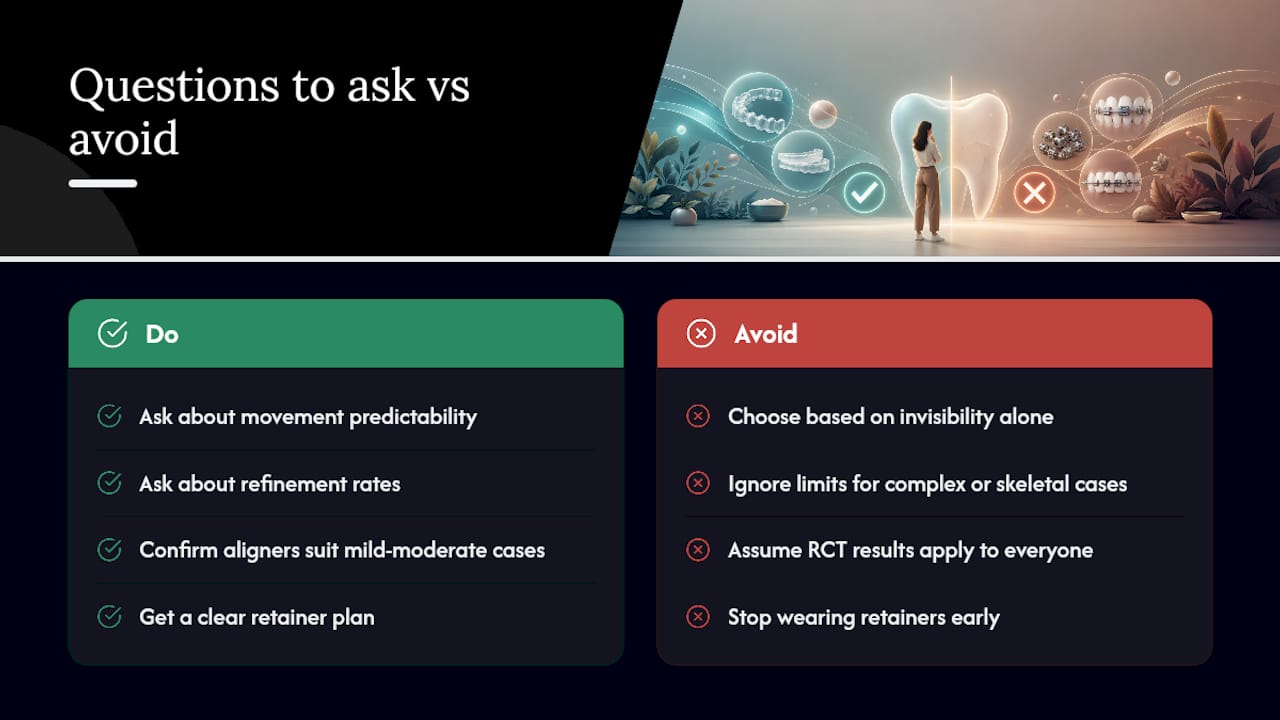
Pro Tip: When you consult an orthodontist, ask specifically: “What percentage of cases like mine require refinement trays?” and “Is there any movement in my plan that you’d consider unpredictable?” Those two questions tell you more about realistic outcomes than any before-and-after photo.
When veneers and bonding make sense — and when they don’t
Veneers and composite bonding don’t move teeth. They change the shape, size, and color of the visible tooth surface to create the illusion of a straighter smile. For the right situation, that’s a perfectly reasonable choice. For the wrong one, it can make things worse.
What these options do well:
- Closing minor gaps between front teeth (diastemas under about 2 mm)
- Reshaping teeth that are slightly uneven in length or width
- Correcting discoloration or minor chips alongside spacing issues
Where they fall short:
- Bite problems: if your upper and lower teeth don’t meet correctly, veneers do nothing to fix that, and may actually interfere with the bite
- Rotational corrections: a tooth that is rotated 20 degrees looks rotated with a veneer on it, just shinier
- Crowding: stacking veneers on crowded teeth makes them look bulkier, not straighter
Red flags to watch for:
- Any provider suggesting veneers as a substitute for orthodontic treatment when your bite is involved
- Enamel reduction (required for traditional veneers) on otherwise healthy teeth without a clear functional justification
- No referral to an orthodontist when you’ve mentioned bite discomfort or jaw pain
Composite bonding is reversible in the sense that it can be removed, but the enamel preparation for porcelain veneers is permanent. Get an orthodontic opinion before committing to either if there’s any question about your bite.
Who is actually a good candidate for aligners?
Clear aligners work well for a specific profile. Mild to moderate crowding or spacing, minor Class I bite discrepancies (where the jaw relationship is essentially normal), and cases without the need for tooth extractions are the sweet spot. Adults and teens with fully erupted permanent teeth are the typical candidates. Younger children whose jaws are still developing usually need a different approach.
Cases that typically require fixed appliances or specialist referral beyond standard aligner therapy:
- Tooth rotations greater than roughly 20 degrees
- Significant overbite, underbite, or open bite with a skeletal component
- Cases requiring extractions to create space
- Severe crowding where teeth are significantly displaced
- Patients with active periodontal disease or significant bone loss
- Skeletal discrepancies that may need orthognathic surgery
The final call always rests on a specialist evaluation: intraoral scan, bite analysis, and radiographs. No symptom checklist replaces that. The AAO is explicit that an orthodontist must evaluate and select the correct appliance for your malocclusion.
What does the process look like, from consultation to retainers?
Step-by-step treatment pathway:
- Consultation: The orthodontist reviews your chief concern, examines your teeth and bite, and discusses whether aligners are appropriate for your case.
- Digital records: An intraoral scan (and typically X-rays) captures your current tooth positions and bone structure in 3D.
- Treatment plan and cost estimate: The clinician builds a virtual simulation of your planned tooth movements. You review it, ask questions, and approve the plan before anything is fabricated.
- Aligner fabrication and fitting: Your custom aligner sets are manufactured and delivered to the clinic. The first appointment includes bonding any attachments and fitting your first trays.
- Staged tray changes and monitoring: You change trays every 7–14 days and attend periodic check-ins (typically every 6–10 weeks) so the clinician can confirm teeth are tracking as planned.
- Refinements (if needed): If some teeth haven’t reached their target position by the end of the initial series, a new scan is taken and additional aligner sets are fabricated. Refinements are common and not a sign of failure.
- Retention: After active treatment, retainers hold your teeth in their new positions. Skipping retainers is the leading cause of relapse. Most orthodontists prescribe full-time wear initially, then nightly long-term.
Typical timelines: Many adult aligner cases for mild to moderate crowding complete within several months, typically under a year. More complex cases can run 18–24 months or longer, especially when refinements are needed.
Cost and insurance: Clear aligner treatment in the U.S. typically ranges from $3,000 to $8,000 depending on case complexity, the system used, and the provider’s market. Many dental insurance plans with orthodontic benefits cover aligners similarly to braces, often with a lifetime maximum of $1,000–$2,000. Flexible spending accounts (FSAs) and health savings accounts (HSAs) can cover the remainder. Most orthodontic practices offer in-house payment plans. For a detailed breakdown of aligner costs and financing, the ClearCorrect cost guide is a useful reference.
Maintenance signs that warrant a call to your clinician:
- A tray feels significantly looser than the previous one (tracking issue)
- A tooth looks like it hasn’t moved between sets
- An attachment falls off
- You notice increased sensitivity or gum recession
What does the clinical evidence actually say?
The strongest evidence comes from a randomized controlled trial comparing clear aligners and fixed appliances in adults with mild to moderate mandibular anterior crowding. Mean alignment improvement was nearly identical: 4.30 mm with aligners versus 4.39 mm with fixed appliances. Average treatment duration was shorter with aligners (8.4 months versus 12.1 months). Early pain scores at 14 days were substantially lower with aligners. Enamel decalcification occurred in no patients treated with aligners versus a measurable rate in those with fixed appliances. These are meaningful differences, though the trial focused on a specific mild to moderate population, so the findings shouldn’t be extrapolated to complex cases.
The international Delphi consensus adds expert-level nuance. The panel agreed aligners achieve comparable results for non-extraction Class I mild to moderate cases and recommended aligner changes every 7–14 days. Critically, they noted that planning unpredictable movements (large rotations, significant root torque, vertical changes) increases the probability of refinements or switching to fixed appliances mid-treatment.
For readers evaluating whether to pursue aligners, the practical takeaway is this: look for a clinician who discusses your specific movements, gives you a realistic refinement rate estimate, and has a clear protocol for what happens if your teeth stop tracking. Vague promises of “perfect results in X months” without that conversation are a yellow flag.
For a deeper look at aligner effectiveness and what the evidence means for your specific case, that resource covers the clinical literature in more detail.
The thing most aligner guides get wrong
Most articles about straightening teeth without braces treat the decision as primarily aesthetic. Pick the least visible option, they suggest, and you’ll be happy. That framing misses the point almost entirely.
The real question isn’t “which option looks most discreet?” It’s “which option will actually move my teeth predictably, given what’s causing my misalignment?” Those are different questions, and conflating them is how patients end up in refinement after refinement, or worse, with a cosmetic fix that masks a bite problem that keeps getting worse.
The evidence is genuinely encouraging for aligners in mild to moderate cases. The RCT data shows comparable alignment outcomes, shorter treatment times, and meaningfully better hygiene outcomes. But that evidence applies to a specific population. The Delphi consensus is equally clear that complex movements, large rotations, and skeletal issues push the limits of what aligners can predictably achieve. A clinician who doesn’t mention refinement rates or movement predictability in your consultation isn’t being thorough.
The other thing that gets glossed over: retention. Orthodontic relapse is real, and it happens faster than most patients expect. The active treatment phase gets all the attention, but the retainer phase is what actually locks in the result. Patients who stop wearing retainers within a year or two often see meaningful drift, especially in the lower front teeth. That’s not a failure of the aligner system. It’s a compliance issue that nobody warned them about clearly enough.
If you’re researching how to fix crooked teeth without braces, the most useful thing you can do is go into your consultation knowing what questions to ask, not just what you want the answer to be.
Glow Orthodontics offers a clear path to specialist aligner care
Patients who want a discreet alternative to metal braces need one thing before anything else: an honest, thorough evaluation from a clinician who will tell them what their teeth actually need, not just what they want to hear.

Gloworthodontics provides specialist orthodontic consultations, in-office intraoral scanning, supervised clear aligner treatment planning, and full retention care. The team works with both Invisalign and ClearCorrect, and the treatment process is mapped out digitally so patients can see their projected tooth movements before committing to anything. Patient testimonials and online booking are available directly on the site.
If you’re ready to find out whether you’re a candidate for aligners, the Invisalign treatment process guide walks through exactly what to expect at each appointment. Book a consultation with Gloworthodontics to get a scan, a realistic treatment estimate, and a plan built around your actual case.
Sources
- Effectiveness of Clear Aligners Versus Fixed Appliances in Correcting Mild to Moderate Crowding
- Indications and limits of clear aligner therapy: an international modified Delphi consensus study | Progress in Orthodontics | Springer Nature Link
This article is general information, not a substitute for advice from a qualified doctor. Consult a qualified healthcare professional about your own circumstances before acting on anything here.