TL;DR:
- In-office clear aligner treatment costs in the United States range from $2,000 to $8,000 with an average of $5,108. The final price varies based on case complexity, provider experience, and location, and requires a comprehensive, written, all-inclusive estimate. Patients should verify coverage details, ask key questions, and ensure supervision by a licensed orthodontist to achieve predictable results.
Professional, in-office clear aligner treatment in the United States typically runs between $2,000 and $8,000, with a national average cost of $5,108 according to 2026 consumer data. Invisalign, the most widely used branded system, tends to sit toward the higher end of that range for comprehensive cases. The single best move you can make right now: book free consultations at two or three licensed orthodontic offices and request itemized written estimates from each.
Three factors drive most of the price variation:
- Case complexity. Minor crowding costs less than a full bite correction.
- Provider experience and office overhead. A high-volume specialist practice in a metro area charges more than a smaller suburban clinic.
- Geography. Fees in New York or San Francisco routinely run $1,000–$2,000 higher than in mid-size cities for the same clinical scope.
Table of Contents
- What does an in-office aligner quote actually include?
- Why can two quotes for the same case differ by $1,500 or more?
- How insurance, HSAs/FSAs, and financing change what you actually pay
- How to compare quotes fairly and what to ask at consultations
- What does the treatment timeline actually look like?
- Why supervised in-office care usually costs more than remote aligners
- Key Takeaways
- The real value of a written treatment plan
- Glow Orthodontics offers in-office Invisalign with no guesswork on cost
- Useful sources
What does an in-office aligner quote actually include?
Most reputable orthodontic practices bundle several services into one flat fee, but not all of them do. Knowing the line items helps you spot a quote that looks cheap because it is missing something important.
| Line item | Typically bundled? | Sometimes billed separately |
|---|---|---|
| Initial consultation | Usually free | Rarely charged |
| Diagnostic records and 3D scan | Usually included | Occasionally extra charges apply |
| Digital treatment planning | Included | Included |
| Aligner trays (full sequence) | Included | Included |
| Refinement trays | Often included | Sometimes capped or extra |
| In-office check visits | Included | Rarely itemized |
| Post-treatment retainers | Sometimes included | Often extra charges apply |
Some practices bundle 3D scans, aligners, refinement trays, and retainers into one flat fee while others itemize and may add charges later. Retainers are the most common surprise charge patients encounter after treatment ends.
Pro Tip: Before signing anything, ask the front desk one direct question: “Is this an all-inclusive flat fee, or will I receive separate invoices for refinements and retainers?” Get the answer in writing.
Why can two quotes for the same case differ by $1,500 or more?
Quotes for the same treatment plan can vary by $1,500 or more between orthodontic offices in the same city because offices set fees based on their own overhead, staffing, and technology investments. That gap is not random.
The main drivers include case complexity, treatment length, provider type, technology used, geographic cost of living, and aligner brand.
One thing worth knowing about certification tiers: a practice’s Invisalign tier is based on annual case volume, not on individualized clinical outcomes. A lower-volume orthodontist who selects cases carefully can deliver excellent results. Volume is a data point, not a guarantee.
Before comparing quotes, confirm each one covers:
- Full aligner sequence for the planned tooth movements
- All refinement trays through case completion
- Post-treatment retainers (or the separate cost if not included)
- Number of included in-office visits
- What happens if treatment takes longer than planned
How insurance, HSAs/FSAs, and financing change what you actually pay
Insurance coverage for clear aligners varies more than most patients expect. Whether aligners are covered depends on the dental plan; some pay a percentage or dollar amount, others exclude them as cosmetic. Plans that include orthodontic benefits often contribute a set dollar amount toward treatment, varying by plan and provider.
The clinical framing matters. A professional orthodontic diagnosis that documents functional bite correction can influence whether a plan classifies treatment as medical rather than cosmetic. If your bite affects chewing or jaw function, ask your orthodontist to document that in the referral or predetermination letter before your insurer makes a coverage decision. You can find a practical checklist for verifying your benefits in this dental insurance and Invisalign coverage guide.
| Funding source | How it helps | Key requirement |
|---|---|---|
| Dental insurance (ortho benefit) | Covers a set dollar amount or percentage | Confirm plan includes adult ortho |
| HSA / FSA | Pre-tax dollars reduce effective cost | Treatment must be medically eligible |
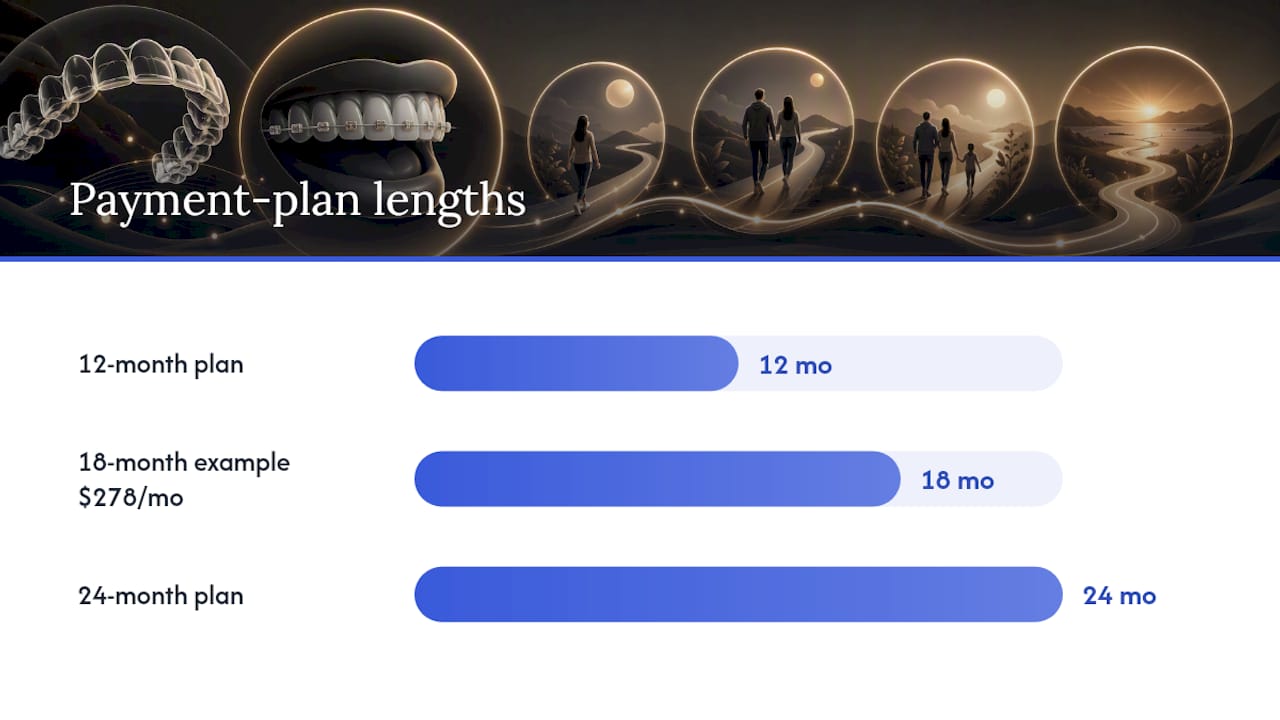
| In-office payment plan | Spreads cost over 12–24 months | Often 0% interest during active treatment |
| Third-party financing | Longer terms available | Interest may apply after promo period |
Many practices offer 12–24 month payment plans; a $5,000 case spread over 18 months works out to approximately $278 per month. That math makes a mid-range case manageable for most household budgets without touching savings.
How to compare quotes fairly and what to ask at consultations
Getting multiple quotes is only useful if you are comparing the same scope of care. A $3,800 quote that excludes refinements and retainers is not cheaper than a $5,200 all-inclusive quote. It is just less transparent.
Verify on every written estimate:
- Is the fee all-inclusive or itemized?
- How many refinement rounds are included, and is there a cap?
- Are post-treatment retainers included or priced separately?
- How many in-office visits are covered?
- What is the estimated treatment length for your specific case?
- What happens if your case needs more trays than planned?
Questions to ask at the consultation:
- Will a licensed orthodontist supervise my treatment at every visit, or will I see a dental assistant?
- How does your practice handle mid-treatment issues or emergencies?
- What digital planning software do you use, and can I see my 3D treatment simulation?
- What is your refinement policy if my teeth do not track as planned?
- Do you offer a written treatment plan with an itemized cost estimate before I commit?
The orthodontic consultation process should always include a 3D scan, a case assessment, and a written estimate. If a provider cannot produce all three before asking for a deposit, that is a red flag. So is any practice that offers aligner treatment without in-person supervision or a clear follow-up schedule.
What does the treatment timeline actually look like?
Clear aligner treatment is not one-size-fits-all on time any more than it is on price. Here is a realistic picture across case types:
| Stage | Mild case | Moderate case | Complex case |
|---|---|---|---|
| Consultation and records | 1–2 visits | 1–2 visits | 1–2 visits |
| Digital planning and lab | 2–4 weeks | 3–5 weeks | 4–6 weeks |
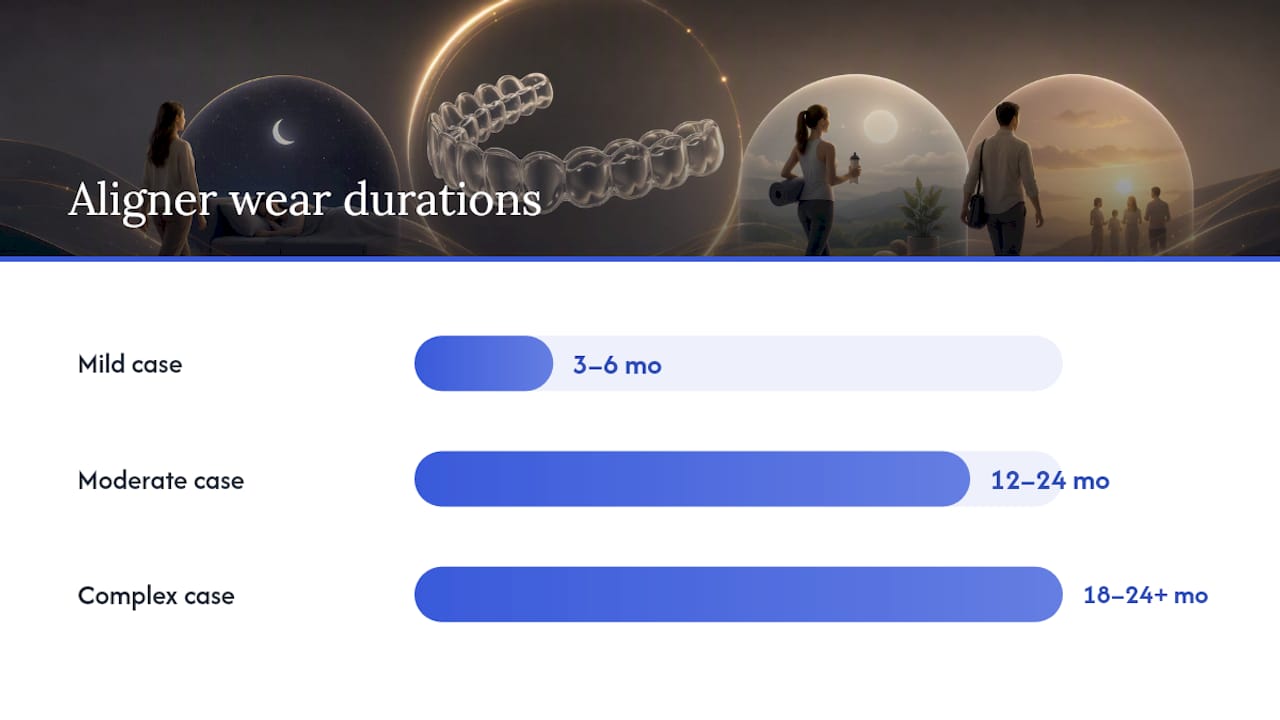
| Active aligner wear | 3–6 months | approximately 12–24 months | 18–24+ months |
| In-office check visits | Every 6–8 weeks | Every 6–8 weeks | Every 4–8 weeks |
| Refinements | Minimal | 1–2 rounds | 2–3+ rounds |
| Retainer phase | Ongoing | Ongoing | Ongoing |
Most patients wear each set of trays for 1–2 weeks and swap to the next set at home. In-office visits are for progress checks, attachment placement or removal, and mid-course corrections. Refinements, where the orthodontist orders a new set of trays to fine-tune the result, are normal and expected, not a sign something went wrong.
Retainers are not optional; consider how using a CBD mouthwash can support your post-treatment oral hygiene for best results as you maintain your new smile with effective retainer care. CBD mouthwash for post-treatment oral hygiene Teeth move throughout life, and skipping retention is the most common reason patients end up back in treatment years later. Understanding orthodontic relapse is worth a few minutes before you finish treatment.
Why supervised in-office care usually costs more than remote aligners
Remote and direct-to-consumer aligner programs advertise lower prices, sometimes significantly lower. The price difference is real. So is the clinical difference.
| Factor | In-office supervised care | Remote / DIY aligners |
|---|---|---|
| Clinical oversight | Licensed orthodontist at every visit | Limited or no in-person oversight |
| Complex tooth movements | Managed with attachments and refinements | Often not suitable |
| Emergency handling | In-office appointment available | Typically mail-based or phone support |
| Digital planning | Full 3D ClinCheck-style simulation | Varies widely |
| Case suitability | Mild to complex | Mild to moderate only |
| Outcome predictability | High for appropriate cases | Lower for anything beyond simple crowding |
In-office treatment prices reflect professional supervision, regular in-person monitoring, and advanced digital planning software to manage complex movements. That overhead is not padding. For significant bite corrections, complex rotations, or vertical tooth movements, in-person supervision materially changes outcomes. Remote programs struggle to predictably manage those movements, and there is no one in the room if something goes wrong.
Pro Tip: If your case involves more than minor crowding or spacing, get an in-person orthodontic evaluation before committing to any remote program. A 3D scan and bite assessment take about 30 minutes and can save you from a costly correction later.
You can read more about how clear aligners actually work before deciding which path fits your situation.
Key Takeaways
Professional in-office clear aligner treatment in the United States costs $2,000–$8,000, averages near $5,108, and requires a written all-inclusive estimate, insurance verification, and in-person orthodontic supervision to protect both your outcome and your budget.
| Point | Details |
|---|---|
| U.S. price range | In-office clear aligner treatment runs $2,000–$8,000; the national average sits near $5,108. |
| Verify all-inclusive pricing | Confirm refinements and retainers are included before signing — these are the most common surprise charges. |
| Ask the right questions | Request a written treatment plan, 3D simulation, and itemized estimate at every consultation. |
| Check insurance eligibility | A formal orthodontic diagnosis documenting functional bite issues can shift coverage from cosmetic to medical. |
| Choose Gloworthodontics for supervised care | Gloworthodontics provides in-office Invisalign with licensed orthodontic supervision, digital scanning, and written treatment plans. |
The real value of a written treatment plan
Patients often focus on the headline price and overlook the document that actually protects them: the written treatment plan. A clear, itemized plan tells you exactly what tooth movements are planned, how many trays are included, what refinements are covered, and what the retention protocol looks like. Without it, you have no benchmark to measure your outcome against and no recourse if the result falls short.
The price difference between a $4,000 and a $6,500 quote often comes down to what is written down and guaranteed versus what is implied and variable. Supervised in-office care from a licensed orthodontist is worth the premium for most patients with moderate to complex cases, not because of the brand name on the aligners, but because a trained clinician is watching the tooth movement at every step and can intervene when the plan needs adjusting. That clinical loop, consult to scan to plan to in-person monitoring, is what remote programs cannot replicate.
Glow Orthodontics offers in-office Invisalign with no guesswork on cost
Patients who want a clear, written number before committing will find that Gloworthodontics delivers exactly that. At a free consultation, you get a full 3D digital scan, a personalized treatment plan, and an itemized cost estimate that spells out what is included, including refinements and retention. No vague quotes, no surprise invoices after treatment ends.

Gloworthodontics provides licensed orthodontist-supervised Invisalign treatment with in-office monitoring at every stage. Flexible payment options and financing are available, and the team will walk you through your insurance benefits before you decide anything. For families and adults comparing options, this is the kind of step-by-step Invisalign process that removes the uncertainty from a significant investment. Book your free consultation at Gloworthodontics and leave with a written plan and a real number.
Useful sources
These are the primary sources used to verify cost figures, insurance guidance, and clinical claims in this article. Bring the insurance links to your consultation when discussing coverage with your orthodontist.
- Does Dental Insurance Cover Invisalign? (Humana) — explains plan-by-plan variability in aligner coverage.
- What Dental Insurance Covers Orthodontics? (Cigna) — covers how a professional diagnosis affects coverage classification.
- Invisalign Cost in 2026: Full Treatment Price Breakdown (ToothCostGuide) — source for quote variability data and the monthly payment example.
- How Much Is Invisalign? (Toothoria) — covers bundled vs. itemized pricing and retainer charges.
This article provides general information about orthodontic treatment costs and is not a substitute for professional advice. Confirm your specific coverage, eligibility, and treatment plan with a licensed orthodontist and your insurance provider.