Most people in the U.S. pay somewhere between $3,000 and $8,000 for braces, with a national average near $5,000 for comprehensive orthodontic treatment — a figure consistent with ADA fee survey data. The range covers both children and adults, though what you actually pay depends heavily on the type of braces, where you live, and your insurance situation. The only way to get a binding number is a diagnostic consultation with an orthodontist.
Quick reference by type:
- Metal braces: typically in the lower price range for affordability and common use
- Ceramic/clear braces: generally cost slightly more and offer less visibility
- Invisalign/clear aligners: popular removable option with moderate cost
Pro Tip: Book a free or low-cost initial consultation before committing to anything. Most orthodontists offer them, and the consult is the only way to get a quote tied to your actual case. Walk in with your insurance card and a list of questions about payment plans.
Key Takeaways
Stacking insurance, FSA/HSA, and in-house financing in the right order can reduce a $5,500 braces case to roughly $100/month — but only a diagnostic consult produces a binding fee tied to your actual case.
| Point | Details |
|---|---|
| Typical U.S. price range | Most comprehensive braces treatment runs $3,000–$8,000, with a national average near $5,000. |
| Insurance lifetime maximum | Most employer dental plans cap orthodontic benefits at $1,000–$2,000 lifetime — check your plan before scheduling. |
| Medicaid for children | EPSDT may cover medically necessary orthodontic care for children under 21; eligibility rules vary by state. |
| Stack your savings | Apply insurance first, then FSA/HSA, then in-house 0% financing to minimize out-of-pocket cost. |
| Gloworthodontics next step | Book a consult at Gloworthodontics for a written, itemized fee estimate and financing options tailored to your case. |
Table of Contents
- What is the average price for braces by type?
- What people actually pay: national averages, insurance, and Medicaid
- Why your quote might look very different from the average
- How to pay for braces and cut your net cost
- Common extras that aren’t always in the headline price
- How treatment length connects to what you pay
- How these price ranges were compiled
- A note on realistic expectations from an orthodontic team
- Gloworthodontics offers transparent consultations and flexible financing
- Sources
What is the average price for braces by type?
The sticker price for braces varies more by type than most people expect. A standard metal case and a lingual case can differ by $6,000 or more, even for the same patient. Dentalplans and Oral-B’s consumer guide both confirm the ranges below.
| Type | Typical U.S. Price Range | Best For | Visibility | Typical Treatment Length |
|---|---|---|---|---|
| Metal (traditional) | $3,000–$7,000 | Children, teens, complex cases | High | 18–36 months |
| Ceramic/clear brackets | $4,000–$8,000 | Teens, adults wanting less visibility | Moderate | 18–36 months |
| Self-ligating brackets | $3,500–$8,000 | Patients wanting fewer adjustments | Moderate to high | 18–30 months |
| Lingual (behind teeth) | $8,000–$13,000 | Adults prioritizing full invisibility | Very low | 18–36 months |
| Invisalign/clear aligners | $3,500–$7,000 | Mild to moderate cases, adults, teens | Very low | 12–24 months |
| At-home DTC aligners | $1,500–$2,500 | Minor cosmetic corrections only | Very low | 4–6 months |
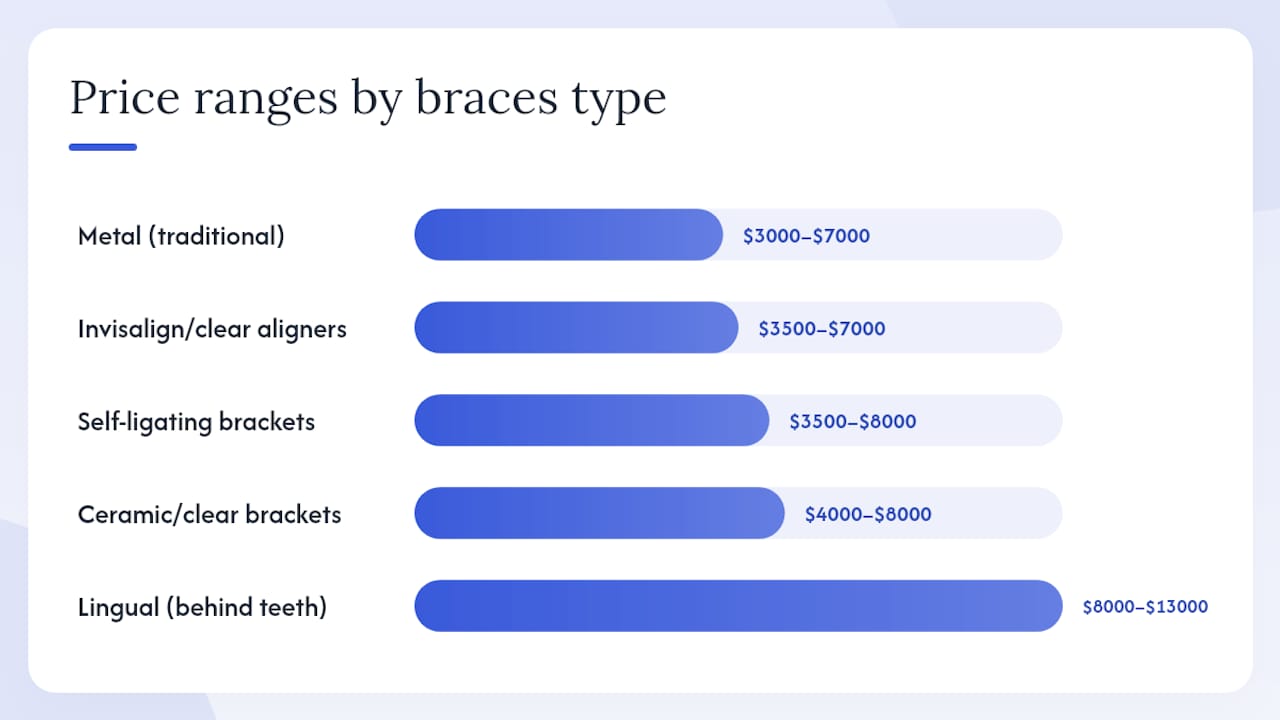
Lingual braces sit at the top of the price range for a specific reason: the brackets are custom-fabricated in a dental lab to fit the back surface of each individual tooth. That precision manufacturing, combined with the technical difficulty of placing and adjusting them, drives costs well above any other option. RealDentalCosts notes that the quoted “base” price in marketing typically assumes a standard, low-complexity case — lingual cases almost never qualify as standard.
At the other end, at-home direct-to-consumer aligners typically run $1,500–$2,500 and are limited to minor cosmetic corrections. They skip the in-person diagnostic step entirely, which makes them unsuitable for anyone with bite issues, significant crowding, or jaw alignment concerns. For a deeper look at how Invisalign compares to traditional braces, the treatment-length and complexity differences are worth reviewing before you decide.
Pro Tip: Provider experience and lab costs drive the upper end of every range. An orthodontist using digital scanning, custom-fabricated brackets, or advanced aligner software pays more for those tools — and that cost passes through to the patient. Asking what technology a practice uses is a fair question at any consult.
What people actually pay: national averages, insurance, and Medicaid
The ADA’s Survey of Dental Fees places the national average for comprehensive orthodontic treatment at a moderate mid-range figure before insurance is applied. What you pay out of pocket depends on three things: whether you have dental insurance with an orthodontic benefit, what that benefit’s lifetime maximum is, and whether your child qualifies for Medicaid coverage.
ADA fee survey anchor: The national average for comprehensive orthodontic treatment sits near $5,000–$6,000 before insurance. Most patients with employer-sponsored dental coverage reduce that by $1,000–$2,000 through their plan’s lifetime orthodontic maximum.
Three realistic scenarios:
- No insurance: You pay the full contracted fee, typically $3,500–$7,000 for metal or ceramic braces. Ask about in-house payment plans and dental-school alternatives (covered below).
- Employer plan with orthodontic benefit: Most employer dental plans carry a lifetime orthodontic maximum of $1,000–$2,000, not an annual benefit. A $5,500 case with a $1,500 lifetime max leaves $4,000 out of pocket before any other strategies. Check your plan’s waiting period — many require 12 months of enrollment before orthodontic benefits activate.
- Medicaid child coverage: Medicaid’s EPSDT benefit can cover medically necessary orthodontic care for children under 21, but eligibility and the definition of “medically necessary” vary by state. Some states cover only severe malocclusions; others are more inclusive. Check your state’s Medicaid dental page directly for current rules. Parents researching braces insurance coverage will find a detailed breakdown of how lifetime maximums and waiting periods work in practice.
FSA and HSA accounts are another lever. Orthodontic treatment qualifies as an eligible medical expense under both, so pre-tax dollars can cover whatever insurance leaves behind.
Why your quote might look very different from the average
Case complexity and geography are the two biggest drivers of price variation, and they can push a quote $2,000 or more above or below the national average. A peer-reviewed analysis in PMC confirms that treatment complexity and the need for adjunctive procedures are primary cost drivers in orthodontic care.
Case complexity covers everything from mild crowding (lower cost, shorter treatment) to severe skeletal malocclusions requiring jaw surgery or palatal expanders before braces even go on. Each additional procedure adds to the total. A patient needing two extractions, a palatal expander, and 30 months of treatment will pay significantly more than someone with mild crowding corrected in 18 months.
Geography matters more than most people realize. Metropolitan areas — particularly the Northeast, California, and major Midwest cities — typically price above rural markets. Oral-B’s pricing guide notes that orthodontists in high-cost urban markets reflect higher overhead in their fees.
Provider type also shifts the number. A board-certified specialist orthodontist generally charges more than a general dentist offering limited orthodontic services. For complex cases, that premium is usually worth it.
Three rough scenarios to illustrate how these drivers stack:
- Low end ($3,000–$4,500): Mild crowding, teen patient, metal braces, 18-month treatment, rural or mid-size market, no auxiliary procedures.
- Mid range ($5,000–$7,000): Moderate crowding with a minor bite issue, adult patient, ceramic braces or Invisalign, 22-month treatment, suburban market, one extraction.
- High end ($8,000–$13,000+): Severe malocclusion, lingual braces or surgical case, 30+ months, metropolitan market, multiple auxiliary procedures.
How to pay for braces and cut your net cost
The sticker price is rarely what you end up paying if you stack your available resources in the right order. ToothCostGuide’s affordability guide lays out the full toolkit; here is how each piece works:
- Dental insurance: Apply your lifetime orthodontic maximum first. Even $1,000 off a $5,500 case matters.
- FSA/HSA: Contribute the maximum allowed for the treatment year and pay the remaining balance with pre-tax dollars. A $2,000 FSA contribution at a 22% effective tax rate saves roughly $440 in taxes.
- In-house 0% financing: Many orthodontic practices offer 12–24 month interest-free payment plans. No credit check, no interest — just a down payment and monthly installments.
- Third-party financing (CareCredit, Lending Club): Useful when in-house plans don’t cover the full balance. Read the deferred-interest terms carefully — missed payments can trigger retroactive interest.
- Dental school programs: University orthodontic residency programs often charge 40–60% less than private practice rates. Treatment takes longer because residents work under faculty supervision, but the clinical quality is closely monitored. For a family willing to trade some convenience for savings, this is one of the most underused options. More on affordable braces options is worth reviewing if budget is the primary concern.
- Sliding-scale and charity programs: Organizations like Smiles Change Lives and some state dental associations offer subsidized treatment for qualifying low-income families.
Worked example: $5,500 case — subtract $1,500 insurance lifetime max, then apply $2,000 from an FSA. The remaining $2,000 goes on a 20-month in-house 0% plan at roughly $100/month. That is the math behind why stacking strategies in order matters.
Pro Tip: Always apply insurance first, then FSA/HSA, then ask about in-house plans. Doing it out of order — for example, putting the full balance on a third-party loan before using your FSA — costs you money you did not need to spend.
Common extras that aren’t always in the headline price
The number an orthodontist quotes at a consult is usually for the active treatment phase. Several related costs may be billed separately, and they add up. DentalPlans.com flags that retainers, final refinements, and post-treatment visits are commonly charged outside the treatment contract unless you ask.

For retainer costs specifically, online retainer providers can be a cost-effective option after treatment ends. ClearRetain’s retainer pricing guide explains why online retainers often cost less than in-office replacements and when that route is appropriate.
A realistic full-case total: $5,500 for braces + $400 for records + $300 for a retainer set + two emergency visits at $75 each = approximately $6,350. That is the number to budget for, not the headline fee. Ask every provider at your consult which items are included in their quoted fee and which are billed separately.
How treatment length connects to what you pay
Longer treatment means more appointments, more materials, and more provider time — all of which feed into the final fee. The connection is not always linear, but it is real.
Typical treatment lengths by type:
- Metal braces: 18–36 months (average around 22 months for moderate cases)
- Ceramic braces: 18–36 months, similar to metal
- Lingual braces: 18–36 months, often toward the longer end due to adjustment complexity
- Invisalign/clear aligners: 12–24 months for mild to moderate cases
- Short-term cosmetic options: 6–12 months, limited to front-teeth alignment only
The monthly payment angle matters here. A $6,000 case spread over 24 months at 0% interest runs $250/month. The same $6,000 on a 12-month plan is $500/month. Budget Seniors’ monthly payment analysis puts most full cases at $100–$250/month after a typical down payment and insurance credits are applied — which aligns with the worked example above.
Short-term cosmetic options look cheaper per month but cover a narrower range of problems. A patient with a bite issue cannot use a 6-month cosmetic option and expect a stable result. The orthodontic consultation process is where a provider determines which treatment length is actually appropriate for your case.
Timeline example: A 24-month case at $5,500 (after $1,500 insurance credit) = $4,000 remaining, or about $167/month on a 24-month 0% plan. A 12-month short-term case at $3,500 = $3,500 remaining, or $292/month. The longer case costs more total but less per month.
How these price ranges were compiled
The ranges in this article come from published fee surveys, professional association guidance, peer-reviewed research, and Medicaid policy documentation. No single source covers every case type and geography, so ranges reflect the consensus across multiple authoritative inputs.
Primary sources consulted:
- ADA Survey of Dental Fees: The American Dental Association’s fee survey provides national averages for comprehensive orthodontic treatment, used here as the anchor figure.
- American Association of Orthodontists (AAO): The AAO’s guidance on treatment considerations and case complexity informed the discussion of cost drivers and provider-type differences.
- Medicaid / EPSDT policy pages: Federal Medicaid documentation on the EPSDT benefit was used for the children’s coverage section; state-level rules vary and readers should verify with their state’s Medicaid office.
- NCBI / PMC peer-reviewed analysis: Academic research on orthodontic treatment complexity and cost drivers supported the factors section.
- Industry price surveys (DentalPlans.com, Oral-B, RealDentalCosts, ToothCostGuide, Budget Seniors): Consumer-facing price aggregators and industry guides provided per-type ranges and payment benchmarks.
A note on realistic expectations from an orthodontic team
Every case is different, and that is not a disclaimer — it is the most useful thing to understand before you start comparing prices online. A quote you see on a website, including the ranges in this article, reflects averages across thousands of cases. Your case has a specific malocclusion, a specific jaw structure, and a specific treatment timeline that no published range can capture precisely.
What a good orthodontic practice will do at a consult: take diagnostic records, review your bite and crowding, and give you a written fee estimate tied to your actual treatment plan. That estimate should itemize what is included and what is not. If a provider cannot or will not do that, ask again or get a second opinion.
The consult is also the right moment to ask about payment plans, insurance coordination, and whether the practice offers any assistance programs. Most practices want to find a path that works for your budget.
Gloworthodontics offers transparent consultations and flexible financing
Patients who want a precise, personalized cost estimate rather than a range have one clear next step: book a consultation at Gloworthodontics. The practice offers comprehensive orthodontic care including traditional braces and Invisalign treatment, with a transparent fee process that walks you through exactly what your treatment includes and what it costs before you commit to anything.

Flexible financing options are available in-office, and the team can help coordinate your dental insurance benefits so you know your out-of-pocket number upfront. Families with teens can also review orthodontic care options for teens to understand timing, coverage, and what to expect at each stage. A consult is required for a binding quote — but it is the most useful hour you can spend before making this decision. Book online at Gloworthodontics or call the office directly.
Sources
These are the primary sources used to compile the ranges and insurance guidance in this article. Each is worth visiting directly if you want to verify figures or check program rules for your state.
- Dentalplans
- How Much Do Braces Cost? – Oral-B
- Early and Periodic Screening, Diagnostic, and Treatment (EPSDT) – Medicaid
- NCBI / PMC article (relevant orthodontic treatment analysis)
- Braces Cost 2026: Metal, Ceramic, Lingual & Aligners – RealDentalCosts
- Average Cost of Braces Per Month — Complete Price Guide – Budget Seniors