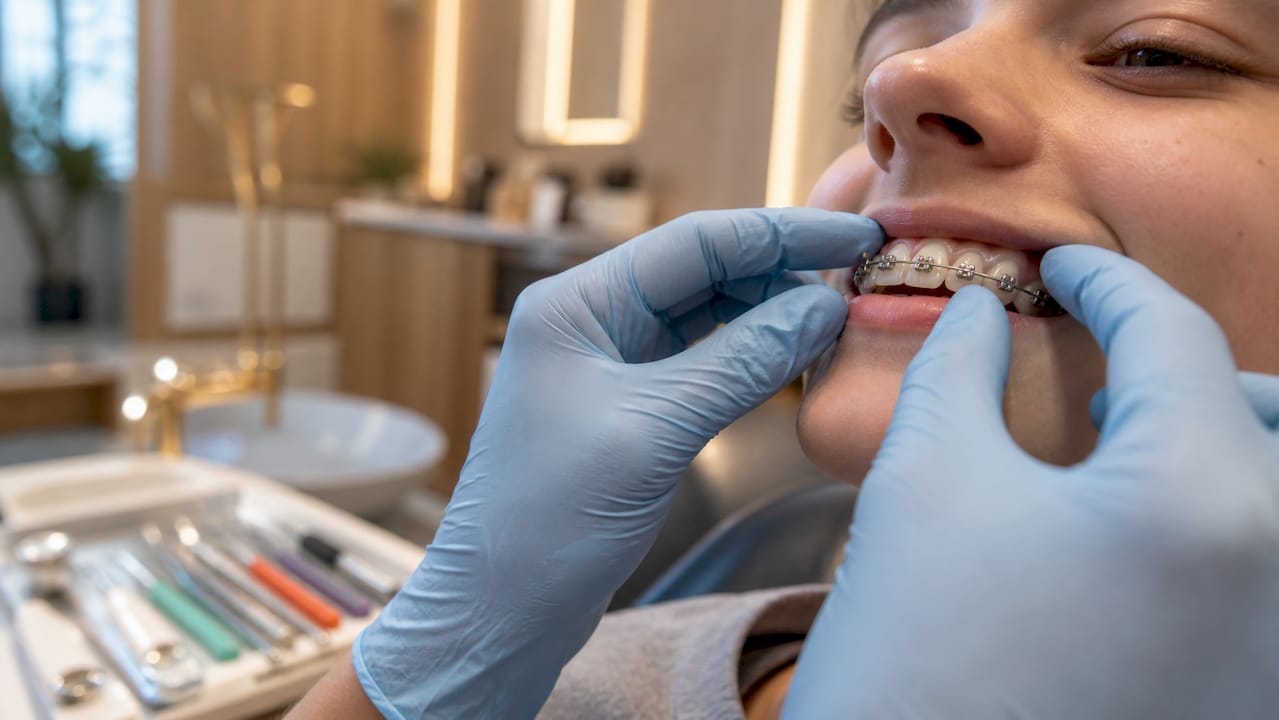
Teens generally have a biological edge in orthodontic treatment — growing jaws respond to orthopedic appliances that simply aren’t an option once skeletal development is complete. That said, adults achieve excellent outcomes with the same core appliances; the difference is in approach, not potential. For families starting a teen on braces, expect growth-guided correction, a typical active treatment window of up to two years, and a strong retainer commitment afterward. Adults starting later should expect a treatment plan that coordinates with any existing dental work and addresses periodontal health concerns, and the same finish line — a functional, well-aligned bite, achieved through treatment.
The American Association of Orthodontists is clear: there is no strict upper age limit for orthodontic care. What changes with age is the biology underneath the treatment, and that shapes every decision from appliance choice to timeline.
Key Takeaways
Teen orthodontics offers growth-guided correction that adults can’t access, but peer-reviewed evidence shows overall treatment duration is not significantly longer for adults — making timing a clinical decision, not a deadline.
| Point | Details |
|---|---|
| Growth is the real teen advantage | Teens can use expanders and functional appliances to correct jaw discrepancies; adults cannot once growth is complete. |
| Adults achieve comparable outcomes | Research shows no statistically significant difference in overall treatment duration between teens and adults with fixed appliances. |
| Appliance fit matters more than age | Matching the appliance to the patient’s daily habits — not just their malocclusion — is the strongest predictor of a smooth case. |
| Retainers are non-negotiable at any age | Full-time wear for roughly six months post-treatment, then nightly indefinitely, prevents relapse for both teens and adults. |
| Gloworthodontics for both groups | Gloworthodontics offers teen-focused and adult orthodontic options, from growth-phase appliances to Invisalign and retention programs. |
Table of Contents
- How biology and jaw growth change orthodontics for teens vs adults
- Which treatment options suit teens and adults differently
- How daily life and compliance look different for teens and adults
- What treatment timelines actually look like — and what the research says
- How cost and insurance coverage differ between teen and adult orthodontics
- How to decide on timing: questions to ask before starting
- What peer-reviewed research and major organizations actually say
- An editorial perspective on what the age debate misses
- Gloworthodontics offers personalized care for teens and adults at every stage
- Sources
How biology and jaw growth change orthodontics for teens vs adults
Age isn’t just a number in orthodontics — it’s the single biggest variable in what’s mechanically possible.
What’s different in a growing patient:
- Jaw and facial growth in adolescents allows orthodontists to redirect bone development, not just move teeth. Palatal expanders widen the upper arch; functional appliances like the Herbst or Twin Block correct jaw discrepancies by harnessing growth spurts. Once the growth plates close, these tools lose most of their effect.
- Bone remodeling rate is faster in teens. Younger bone responds more readily to the light, sustained forces orthodontic appliances apply, which is why tooth movement can feel quicker in adolescence.
- Periodontal considerations shift with age. Adults are more likely to present with gum recession, bone loss, or a history of periodontal disease. Active periodontal disease must be controlled before any orthodontic force is applied — moving teeth through compromised bone accelerates damage.
- Existing restorations complicate adult treatment. Crowns, bridges, and implants don’t move with orthodontic force. Implants in particular are fused to bone (osseointegrated) and act as anchors, which can limit tooth movement options and require multidisciplinary planning with a restorative dentist.
- Bone density is higher in adults, which means slower cellular response to force and a greater need for precise force calibration to avoid root resorption.
- Skeletal discrepancies that would be corrected with growth guidance in a teen may require orthognathic (jaw) surgery in an adult if the discrepancy is significant enough that tooth movement alone can’t compensate.
Diagnostically, adult workups typically include a more thorough periodontal evaluation and careful review of bone levels on X-rays before treatment begins. For teens, the focus is often on timing relative to growth stage — a lateral cephalometric X-ray helps estimate skeletal maturity so the orthodontist can decide whether to start now or wait for peak growth.
Which treatment options suit teens and adults differently
Every major appliance type works for both age groups, but the fit varies by biology, lifestyle, and case complexity.
Fixed metal braces remain the workhorse for both teens and adults. They handle severe crowding, complex bite corrections, and cases where compliance with a removable appliance is uncertain. For teens with significant skeletal issues, metal braces are often paired with functional appliances or expanders during the growth window.
Ceramic (tooth-colored) braces offer the same mechanical performance as metal with less visual impact. Adults who want a less noticeable fixed option often choose ceramic; teens who are self-conscious about appearance do too, though ceramic brackets can stain if oral hygiene slips.
Lingual braces attach to the back surfaces of teeth, making them essentially invisible from the front. They’re more common in adult treatment because the cost and adjustment complexity are easier to justify when professional appearance is a priority. They’re technically demanding and not every case is a good candidate.
Clear aligners (Invisalign and similar systems) are popular across both groups, but the selection criteria differ. Invisalign Teen includes eruption tabs to accommodate teeth still coming in and compliance indicators that change color with wear — a practical feature for parents monitoring a teenager. Adults tend to prefer clear aligners for aesthetic reasons and often show stronger compliance. The catch: aligners require 20–22 hours of wear per day to stay on track. A teen who consistently removes them at lunch and forgets to put them back will extend treatment significantly. For a detailed breakdown of how clear options compare, clear braces versus Invisalign covers the key trade-offs.
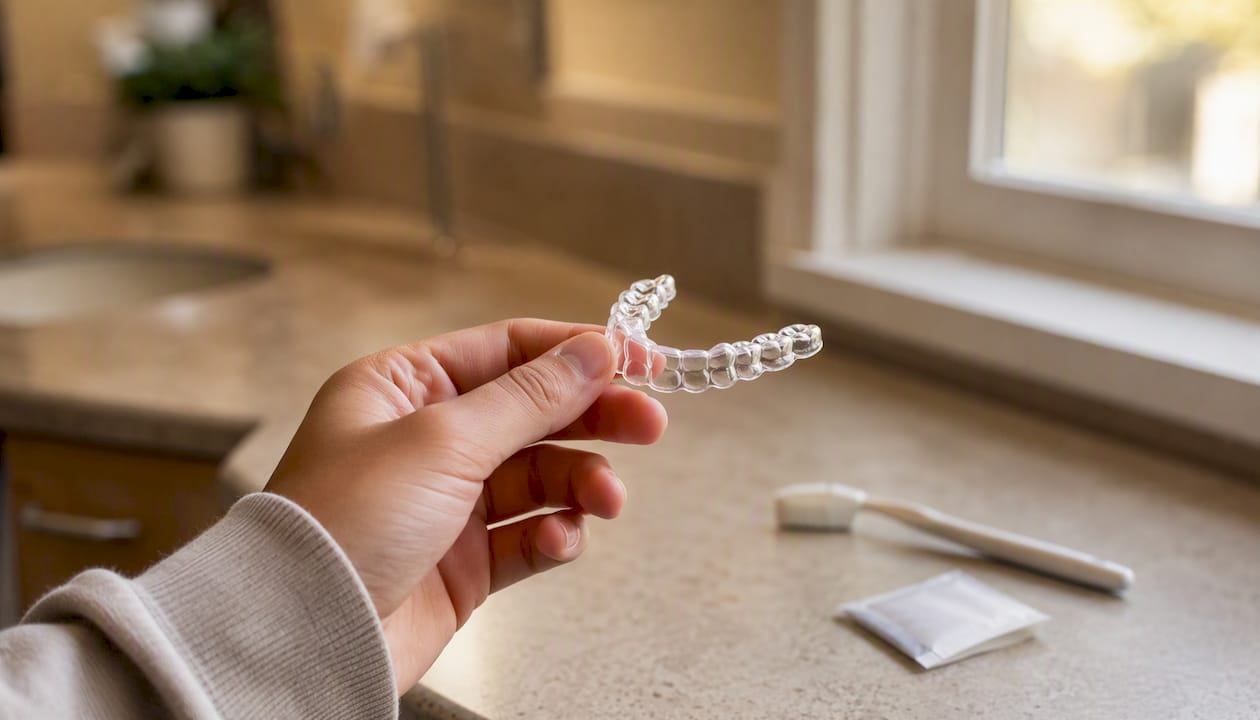
Functional and orthopedic appliances are almost exclusively a teen tool. They work by modifying jaw growth direction and are most effective during the adolescent growth spurt, typically between ages 11 and 14.
Combined ortho-surgery becomes relevant for adults with skeletal discrepancies too large for tooth movement alone. Orthognathic surgery corrects the jaw position; orthodontics aligns the teeth before and after surgery. This path adds significant time and cost but produces results that braces alone cannot.
- Mild to moderate crowding or spacing:
clear aligners are a reasonable choice for motivated patients of any age
- Severe crowding, significant bite issues, or skeletal problems: fixed braces, often with adjuncts
- Adults with crowns, bridges, or implants: multidisciplinary planning with a restorative dentist is standard
- Teens still growing: functional appliances and expanders are on the table; adults are not candidates
Pro Tip: Ask your orthodontist specifically whether your case is “dentoalveolar” (teeth only) or “skeletal” (jaw position). That single distinction determines whether growth guidance is relevant and whether surgery might eventually be part of the adult conversation.
How daily life and compliance look different for teens and adults
Compliance isn’t just about willpower — it’s about what a patient’s daily life actually allows.
Factors that affect both groups:
- Aligner wear time (20–22 hours daily, non-negotiable)
- Elastic wear for bite correction (fixed schedule, easy to forget)
- Appointment attendance (typically every 6–10 weeks)
- Dietary restrictions with fixed braces (no hard, sticky, or crunchy foods)
- Oral hygiene demands (braces trap food; aligners require clean teeth before reinsertion)
For teens, the school day creates real friction. Removing aligners at lunch in a crowded cafeteria feels awkward; sports and contact activities raise questions about mouthguards over brackets. Parents play a meaningful role here. Teens with consistent parental check-ins on wear time and hygiene tend to stay on track better than those managing it independently. That’s not a criticism — it’s just how adolescent motivation works.
Adults face a different set of pressures. Professional settings make visible metal brackets a concern for some patients, which often drives the choice toward ceramic or lingual options. Travel and unpredictable work schedules can make consistent appointment attendance harder. On the other hand, adults generally show stronger appointment adherence and are more likely to follow through on elastic wear because they understand the consequence of not doing so. Appliance selection matched to realistic daily habits is one of the most important factors in predicting a good outcome.
Pro Tip: For teens using aligners, set a phone alarm for reinsertion after every meal. For adults with demanding travel schedules, ask your orthodontist about extended-interval appointments — some practices accommodate 10–12 week gaps without compromising results, depending on the treatment phase.
Oral hygiene is worth its own mention. Braces create more surfaces for plaque to accumulate, and teens are statistically more prone to skipping thorough brushing. Adults aren’t immune, but the motivation to protect existing dental work tends to keep hygiene habits sharper. A natural oral hygiene routine for braces and aligners makes a real difference in preventing white spot lesions and gum inflammation during treatment.
What treatment timelines actually look like — and what the research says
The common belief that adults always take longer in braces than teens is not well supported by the evidence. A systematic review and meta-analysis comparing treatment duration between adolescents and adults — pooling data from 2,969 adolescents and 1,380 adults — found no statistically significant difference in overall treatment duration with fixed appliances (mean difference of −0.8 months, 95% CI −4.2 to 2.6 months; P = 0.65). One exception: palatally displaced canines took longer to align in adults than in teens.
That finding matters because it reframes the conversation. Adults often compensate for slower bone remodeling with better compliance and fewer missed appointments, which tends to equalize the timeline in practice.
Factors that extend treatment for either group:
- Severe crowding or significant skeletal discrepancy
- Ankylosis (a tooth fused to bone, more common in adults)
- Active or previously uncontrolled periodontal disease
- Missing teeth requiring space management before or during treatment
- Poor compliance with elastics or aligner wear
- Gaps between appointments
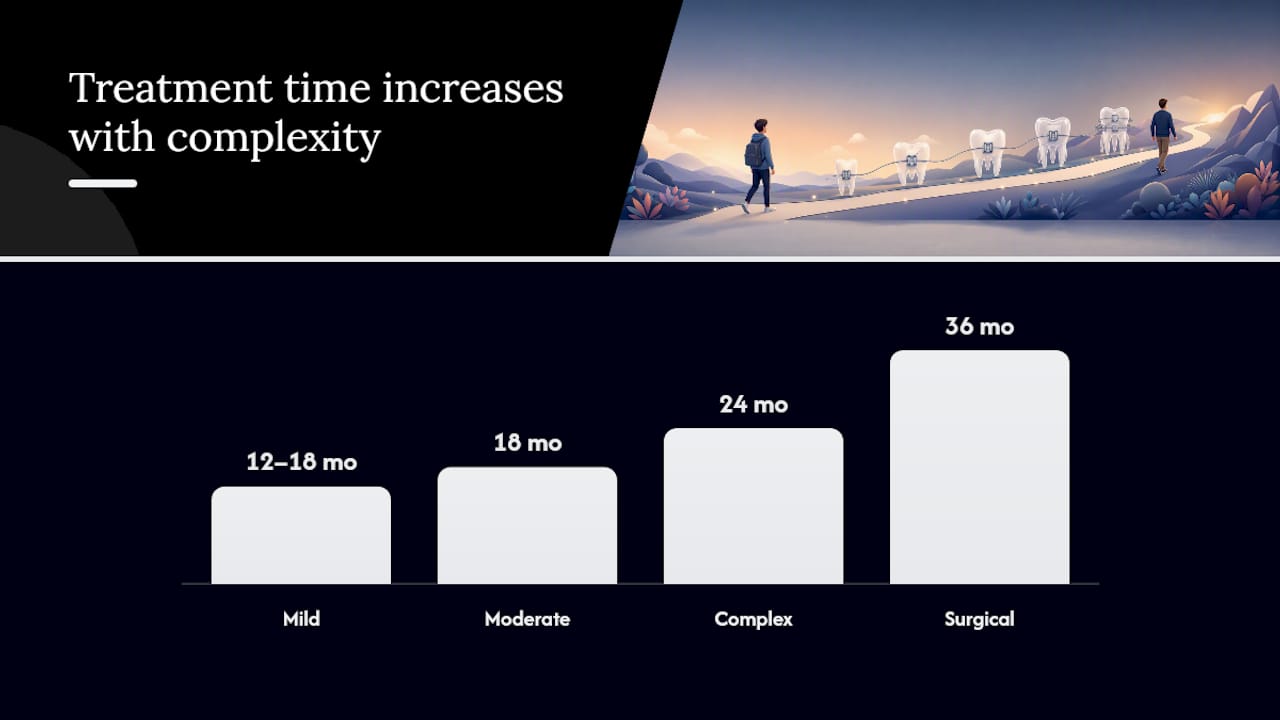
| Complexity Tier | Typical Range | Notes |
|---|---|---|
| Mild (minor crowding, spacing) | 12–18 months | Aligner-friendly; compliance is the main variable |
| Moderate (bite correction needed) | 18 months | Fixed or aligner; elastics usually required |
| Complex (skeletal, severe crowding) | 24 months | Fixed braces preferred; may include expanders for teens |
| Surgical (orthognathic) | 36 months | Pre-surgical ortho + recovery + post-surgical ortho |
The AAO recommends an orthodontic evaluation by age 7 — not because treatment starts then, but because early detection of developing problems allows for interceptive care that can simplify or shorten later comprehensive treatment. Most full treatments begin between ages 11 and 14, when growth is active and all permanent teeth are in. For a deeper look at how long treatment typically runs, how long braces last breaks down the variables by case type.
Retention is non-negotiable at any age. KidsHealth guidance describes the standard pattern: full-time retainer wear for roughly six months after active treatment, then nightly wear indefinitely. Skipping retainers is the most common reason teeth shift back, and that applies equally to a 14-year-old and a 45-year-old.
How cost and insurance coverage differ between teen and adult orthodontics
Cost ranges for orthodontic treatment vary by case complexity, appliance type, and geography, but patient guides commonly report ranges of roughly $3,000–$7,500 for both braces and clear aligners, with significant overlap depending on the case.
The insurance gap between teens and adults is real and significant. Many dental insurance plans set a pediatric age limit — often 18 or 19 — for orthodontic benefits, and adult orthodontics is frequently classified as cosmetic, which excludes it from coverage entirely. Some employer-sponsored plans include adult orthodontic riders, but these are less common and often carry lifetime maximums that don’t cover the full cost.
Practical steps to manage cost:
- Ask your insurer specifically whether orthodontic benefits have an age cutoff and what the lifetime maximum is
- Use a Health Savings Account (HSA) or Flexible Spending Account (FSA) to pay for orthodontic treatment with pre-tax dollars — both are eligible expenses
- Ask the practice about in-house monthly payment plans; most orthodontic offices offer 0% financing over the treatment period
- For families with multiple children, ask whether the practice offers a sibling discount
- Check whether your plan covers a portion of clear aligner treatment specifically — some plans distinguish between “braces” and “aligners” in their benefit language
For parents navigating insurance for clear aligner treatment, dental insurance covering Invisalign explains what to look for in your plan documents.
How to decide on timing: questions to ask before starting
The decision to start orthodontic treatment — and when — comes down to a handful of concrete factors.
Start sooner (teen years) when:
- A skeletal discrepancy is present (underbite, crossbite, significant overbite) and growth is still active
- Crowding is severe enough that early intervention could prevent extractions later
- The AAO’s age-7 evaluation flagged an interceptive need
- The teen is motivated and has parental support for compliance
Adult timing is reasonable when:
- The issue is purely dentoalveolar (teeth, not jaw position)
- Periodontal health is stable and well-maintained
- Existing restorations are in good condition and a restorative dentist is available to coordinate
- Financial and scheduling readiness is in place
Before your consultation, gather:
- Recent dental X-rays (panoramic and bitewing if available)
- A list of existing restorations, implants, or crowns
- Your insurance card and a copy of your benefits summary
- Photos of your smile from the front and side (orthodontists often request these)
- A list of questions about appliance options, timeline, and cost
Getting a second opinion is always reasonable for complex cases, particularly when surgery is mentioned or when the proposed treatment involves extraction of permanent teeth. A second orthodontist’s perspective on those decisions costs little and can confirm or refine the plan.
For families exploring options for a teenager specifically, the orthodontic care for teens guide walks through the full process from evaluation to retention. For a broader look at how dental care adapts across life stages, how dentists treat all ages offers useful context.
What peer-reviewed research and major organizations actually say
The evidence on orthodontics for teens vs adults is more nuanced than most patient-facing content suggests.
The systematic review published in Progress in Orthodontics is the most rigorous comparison available. Its key finding: overall treatment duration with fixed appliances does not differ significantly between adolescents and adults. The one documented exception — palatally displaced canines taking roughly 3.8 months longer in adults — is a specific tooth type, not a general rule.
What the research actually shows: Adults are not categorically slower to treat than teens. The gap, where it exists, is small and case-specific.
The AAO reinforces this: orthodontic treatment can be successful at any age, provided periodontal health is adequate. The organization recommends a first evaluation by age 7 to catch developing skeletal issues early, but that recommendation is about early detection, not a suggestion that treatment must begin then.
Limitations worth knowing:
- Most studies in the systematic review used retrospective designs, which limits causal conclusions
- Heterogeneity across studies (different appliances, case mixes, clinician experience) means individual predictions from population averages carry uncertainty
- Compliance differences between study populations are rarely controlled for, which may mask real-world variation
The honest takeaway: population-level data gives useful benchmarks, but your specific case — bone quality, case complexity, compliance habits — will determine your actual timeline more than your age will.
An editorial perspective on what the age debate misses
The teen-versus-adult framing is useful for explaining biology, but it can mislead patients into thinking timing is the dominant variable. It usually isn’t.
The patients who struggle most in orthodontic treatment — regardless of age — are the ones whose appliance choice didn’t match their actual daily life. A teen who genuinely won’t wear aligners for 22 hours a day should be in fixed braces. An adult who travels three weeks a month needs a practice that can accommodate longer appointment intervals and a treatment plan that accounts for that reality. Matching the appliance to the patient’s life, not just their malocclusion, is what separates a smooth 18-month case from a frustrating 30-month one.
The other thing the age debate tends to obscure: retention is where most long-term outcomes are actually won or lost. A beautifully finished case at 16 or 46 will relapse without consistent retainer wear. The importance of wearing retainers at night doesn’t diminish after the first year — for many patients, it’s a lifelong habit. That’s not a flaw in the treatment; it’s just how teeth work.
Adults who delay treatment because they assume it will take much longer or cost dramatically more than teen treatment are often working from assumptions the evidence doesn’t support. The biology is different, but the outcomes are comparable, and the window is open longer than most people think.
Gloworthodontics offers personalized care for teens and adults at every stage
Choosing between treatment now or later is easier when you have a clear picture of your specific case — not just general population averages.

Gloworthodontics provides orthodontic evaluations, teen-focused treatment including clear aligner options and growth-phase appliances, adult aesthetic options from ceramic braces to Invisalign, and retention programs designed to protect your results long-term. Whether you’re a parent weighing the right time to start for your teenager or an adult who’s been putting this off, the next step is a consultation where the plan is built around your biology, your schedule, and your goals. Explore the Invisalign treatment process or review the complete teen orthodontic guide, then book your exam at Gloworthodontics.
Sources
- Systematic review comparing treatment duration between adolescents and adults — Progress in Orthodontics (Springer)
- How Are Adults Different? — American Association of Orthodontists (AAO)
- Braces and Retainers — KidsHealth (Lurie Children’s)
- Braces for Teens vs. Adults: What’s Different and What to Expect – Pioneer Orthodontics
- Orthodontics For Adults Vs Teens: Key Differences Explained – Smiles by D. Rothman
- Braces vs Invisalign for Teenagers: Which Is Better? – Docs OK Ortho